how a solar geyser actually works on a SA roof
If you have already had three sales people on the roof this month, you probably want the real picture before anyone else climbs up there. This guide treats you as the grown-up in the room and gives you the questions to ask, the numbers to expect, and the traps to avoid when choosing a solar geyser installer.
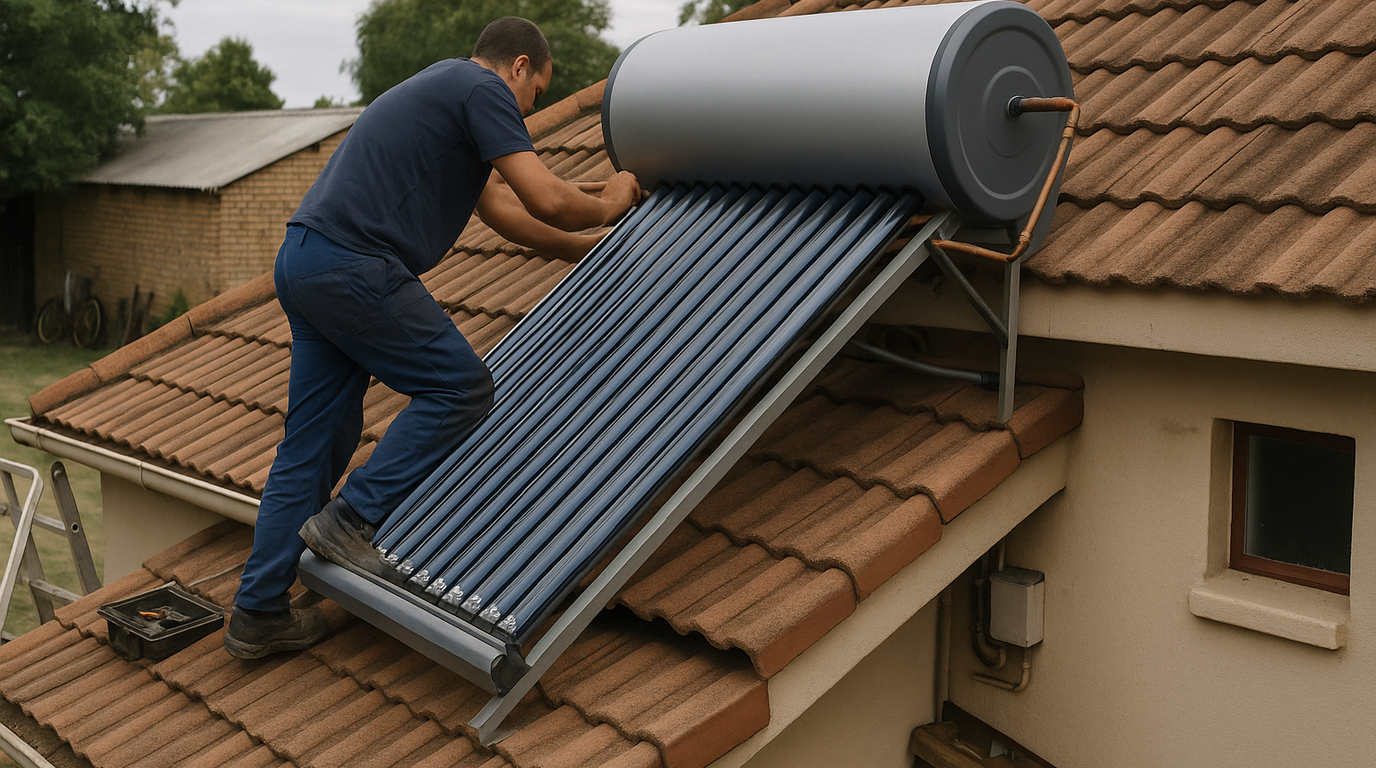
A solar geyser has three working parts. A collector panel on the roof absorbs heat from the sun. A tank stores the water once it has been warmed. A circulation loop — either a pump or, in a thermosiphon design, gravity and convection — moves water or a heat-transfer fluid between the two. Most South African homes also have a backup electrical element inside the tank, so you still have hot water on a cloudy day or after a stretch of outages.
There are two common layouts. A close-coupled system sits low on the roof with the tank just above the collectors, and relies on natural circulation, so no pump and little electronics. A split system puts the tank on the ground or in the roof cavity and uses a pump to push fluid up to the collectors, which is the practical choice when the roof cannot carry the weight or the household wants a larger tank.
The fluid inside most quality systems is food-grade propylene glycol mixed with water. It carries the heat, resists freezing in the Highveld winter, and protects the collector from corrosion. Direct systems circulate plain water and are cheaper, but they scale up faster and need a bigger freeze buffer. For most SA homes the indirect glycol system is the safer buy.
what a solar geyser costs in South Africa
A 150 litre system is the most common size for a three-person South African home, and it is also the most-searched size online. Prices move with tank capacity, collector count, frame type, and how much plumbing the installer has to redo. The honest way to budget is to ask what is included: the tank, the collectors, the frame, the pump where applicable, the electric backup element, new piping, a vacuum breaker, a pressure control valve, and the Certificate of Compliance at the end.
Solar water heating sits inside South Africa’s Small-Scale Embedded Generation framework for systems below 1 MW, which is the bracket any home or small business falls into, according to SAPVIA. That matters because the paperwork rules for an installer are the same whether you are putting up a 150 litre tank or a 5 000 litre commercial plant.
South Africans who pay Personal Income Tax can also claim a rebate on new and unused PV panels through SARS, up to a maximum of R15 000 against their tax liability, as set out by SARS. Photovoltaic panels for power generation are not the same product as a solar thermal collector for water heating, so do not assume the rebate applies to your geyser — ask a tax practitioner to confirm before you file.
Get at least three written quotes. Make sure each one is for the same tank size, the same collector area, and the same scope of plumbing work. The cheapest quote is often the one missing the most parts.
sizing a solar geyser to your home
Undersizing means cold showers. Oversizing means paying for a tank and collectors that earn nothing back. The middle ground is to size for the people in the house and how they actually use water.
how many litres per person
A reasonable rule for South African conditions is 50 litres per person per day for a household that showers rather than baths. A family of four on that rule lands on a 200 litre tank. Add a bit for a bath-heavy household, and round up rather than down, because the backup element is there for a reason.
collector count and roof space
A 150 litre tank usually wants one 2 m2 collector. A 200 or 300 litre tank usually wants two. The collectors need a north-facing run of roof with no midday shade from trees, a neighbouring wall, or a dormer. If the only north-facing stretch is too small, a split system with the tank on the ground is the honest answer, not a forced fit that underperforms.
solar geyser versus heat pump: which suits your home
A solar geyser uses the sun directly to heat water. A heat pump uses electricity to move heat from the air into the water, the way a fridge runs in reverse. Both cut your bill. They behave differently in the real world.
A heat pump works day and night, in cloudy weather, and does not need a north-facing roof. It draws current though, so during a long stretch of outages the tank will cool down unless you have a backup source. A solar geyser stores heat for free once the sun has done the work, but loses more of that heat on an overcast week in winter and wants the roof orientation right.
For homes with a good north roof and a household that uses most of its hot water in the morning and evening, the solar geyser is usually the cheaper thing to run. For homes with shaded or east-west roofs, or households that want a single unit to cope with load reduction, a heat pump is often the simpler choice. A hybrid system — solar collectors feeding a heat-pump loop — exists, but it is more kit on the roof and more to service, so it only earns its keep on bigger homes.
what to check before you book an installer
Before anyone steps on your tiles, run a quick vet. It is a ten-minute job and it saves weeks of chasing.
the paperwork that should come with the job
Ask for the company’s registration, a recent reference from a job in your area, and proof of public liability cover. On completion, a registered electrician must issue a Certificate of Compliance for any electrical work done — the backup element, the pump, and any new circuit. Eskom and municipal supply rules still apply, and the COC is what your insurer will ask for if you ever claim.
questions to put to the installer on site
Ask which system is closed-loop glycol and which is direct, because they behave differently in winter. Ask what the backup element is rated at and whether the existing DB board can carry it. Ask how they will flash the roof around the frame, because a bad flashing job is the most common leak we see on older installations. Ask who carries the warranty and what it covers.
If you want a deeper primer on the technology before the quote arrives, the page on how solar geysers work lays out the same parts in a little more detail.
reading a solar geyser quote line by line
A clean quote breaks the job into parts you can price and challenge. Look for each of these lines, in plain language, with a Rand amount against them:
- Tank, brand and capacity in litres.
- Collector, brand and area in square metres, plus frame type.
- Pump and controller where the system is split.
- Mounting frame, roof hooks, and flashing kit.
- Plumbing: new pipe, valves, vacuum breaker, pressure control, non-return valve.
- Electrical: element, isolator, cable run, and the COC from a registered electrician.
- Labour for the installation day.
- Transport and travel, especially for out-of-town sites.
- Removal of the old geyser if there is one.
- Warranty terms on the tank, the collectors, and the workmanship.
If two quotes are far apart in price, they are usually not quoting the same job. Match line for line before you decide. The cheapest quote that omits flashing or the COC is not the cheapest quote — it is the most expensive one once the leaks and the re-inspection start.
payback and monthly savings, in plain terms
Typical payback on a correctly sized solar geyser in a South African home lands somewhere in the rough range of three to six years. The exact figure depends on what you pay for a kilowatt-hour from Eskom or your municipality, how many litres of hot water your household actually uses, the size of the system, and the time of day most of that hot water is drawn.
Grid context matters here. Eskom has confirmed that NERSA approved an average electricity price increase of 8.76% for direct Eskom customers, with municipal bulk purchasers averaging a 9.01% increase from 1 July 2026, as reported by Eskom. The CSIR has tracked a longer pattern, with the national average electricity tariff rising by an average of 10% per year from 2014 to 2024, well ahead of average inflation of 5.2% over the same period, according to the CSIR. Every percentage point on the tariff moves payback closer to the short end of that range.
Outages push payback the other direction only if your household relies on the backup element most days. Most well-sized systems stay ahead of the grid because the sun does the heating whether the grid is on or not.
living with a solar geyser day to day
Once the system is in, the household routine barely changes. The sun heats the water during the day. The tank holds it. The backup element catches the gaps. The only real adjustment is that hot water is at its best late afternoon and into the evening, with a smaller top-up in the morning if the tank is large enough.
maintenance, in plain terms
A yearly check is enough for most homes. The installer should look at the glycol mix, the pressure relief valve, the anode in the tank if one is fitted, the pump and controller on a split system, and the electrical side including the element and the isolator. The homeowner only needs to keep an eye out for dripping valves, a damp patch around the frame after rain, and any drop in hot water volume that does not track back to a cold week.
cloudy weeks and winter output
A solar geyser does not stop on a cloudy day. Output drops, but a north-facing system with a closed-loop glycol mix will still lift the tank to a useful temperature through overcast stretches. In winter the tank loses more heat overnight, so morning showers rely more on the backup element. That is by design, and it is why sizing matters: an undersized tank forces the element on every morning of June.
choosing an installer in Gauteng, Cape Town, Durban and the rest of SA
Solar geyser work is done by a partner network of approved installers rather than by a single branch. That model keeps travel costs down and gets a local crew on site, but it also means the quality of the job sits with the specific installer who lands on your roof, not with a head office you may never visit. Ask which crew will do the work, where their last three jobs were, and who handles a warranty call if something goes wrong in year two.
The broader market for rooftop solar has grown quickly. GreenCape puts total rooftop solar PV installed capacity in South Africa at 3.2 GW by 2023, with an estimated total addressable market across residential, commercial and industrial rooftops of roughly 10 GW that could come online by 2030, according to GreenCape. A hot water tank is not a PV panel, but the same contractor base is doing the work, and the same rules on registration and after-sales apply.
In Gauteng the winter freeze risk and the higher altitude push installers toward indirect glycol systems. In Cape Town the milder climate allows direct systems on more homes. In Durban and the KwaZulu-Natal coast humidity is the bigger enemy of unprotected frames, so stainless hardware pays for itself. Wherever you sit, the checklist is the same: registration, references, scope of work, COC, and warranty terms.
book a site visit
If you want a number that is actually yours — not a range off a webpage — book a site visit. A local approved installer will check the roof orientation, measure the north run, look at the existing plumbing, and price the job against what is really up there. Schedule a site visit and the quote that comes back will be one you can compare line for line against the rest.
FAQ
How much does a solar geyser cost in South Africa? A 150 litre system for a three-person home is the most common size, and a quality install with a COC sits in a mid-range bracket that varies with tank capacity, collector area, and how much plumbing has to be redone. Get three written quotes matched line for line.
What is the best solar geyser size for a 4-person home? A 200 litre tank with two collectors is a sensible starting point for a four-person household that showers rather than baths, with a 300 litre tank worth considering if the home has two bathrooms.
How long does installation take? Most residential solar geyser installations are done in a single day, with the electrical sign-off and COC following shortly after.
Do solar geysers work during outages? Yes. The collectors heat the water whenever the sun is on the roof, and the tank stores that heat, so the system is largely independent of the grid except for the backup element.
How long is the warranty on the equipment? Equipment installed by an approved installer carries a 10 year swap-out warranty, on the condition that the installation was completed by an approved installer in the network.