Why solar geyser size matters
Getting your solar geyser size right is the single most important decision in a solar water heating installation, more important than any brand choice. Undersize the tank and the backup element works overtime on winter evenings, quietly eating into the savings you bought the system for. Oversize it and you’ve paid for capacity that sits unused most of the year. This guide works through the common sizes, how to estimate your own household’s need, and what actually drives the payback, so you can land on a capacity with confidence instead of a guess.
Understanding the technology: the two choices behind every size
Before you settle on a litre figure, it helps to know what sits behind it. Every solar geyser pairs a tank with a collector, and the collector type and system layout affect how well a given capacity performs at your address.
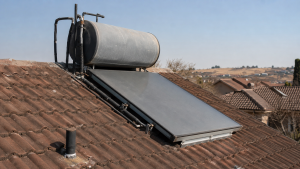
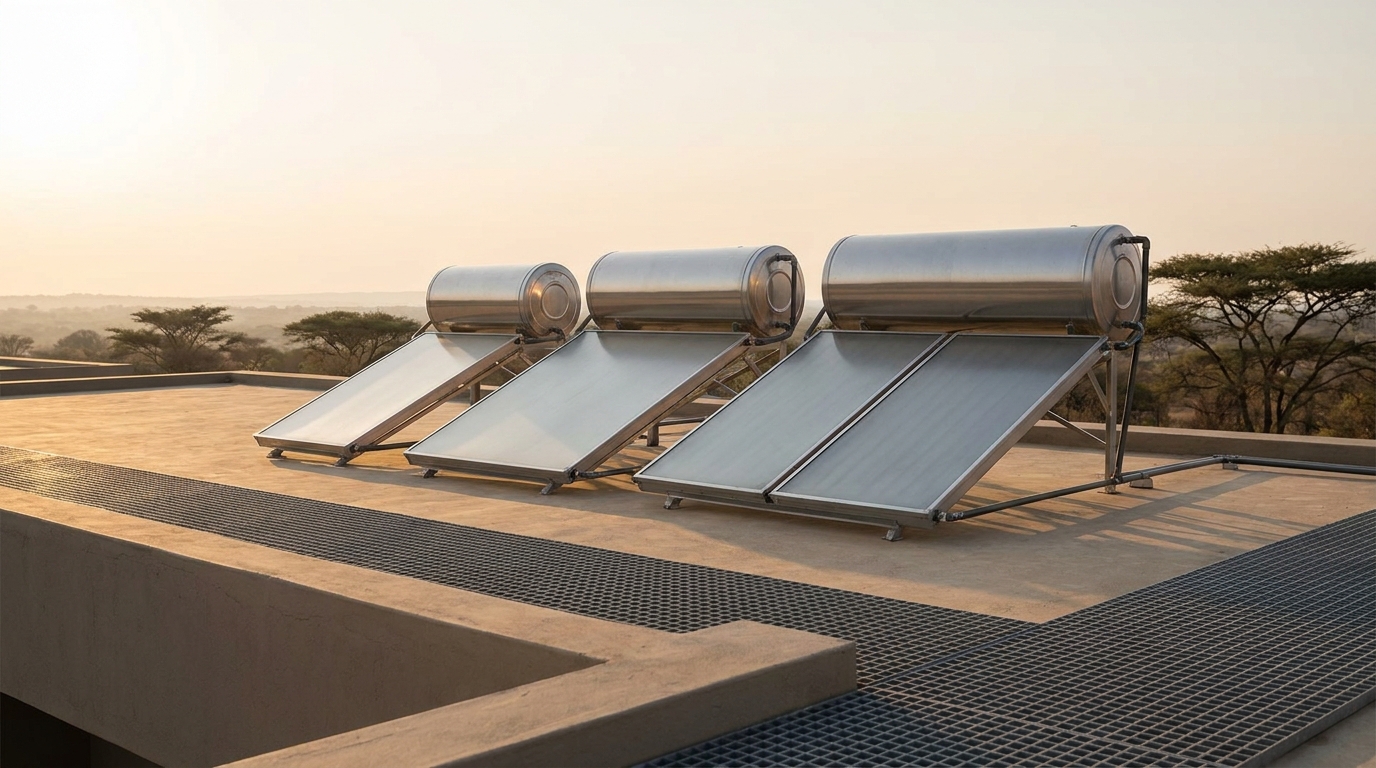
Flat plate collectors use a dark absorber plate under glass, plumbed with tubes carrying water or fluid. They’re simpler and tend to cost less to install. Evacuated tube collectors use a row of vacuum-sealed glass tubes, which insulate better and keep producing hot water on colder mornings or when the sun is weaker.
The second choice is direct versus indirect. A direct (open loop) system circulates your actual tap water through the collector and back into the tank. It’s straightforward and works well in areas that rarely see frost. An indirect (closed loop) system circulates a separate fluid through the collector and passes the heat to your tank water through a heat exchanger, which protects the system from freezing in colder inland regions. Think of this as the first real decision you’ll make with your installer partner. Get the collector and loop type right for your climate, then size the tank.
Common solar geyser sizes and who they suit
Once the technology choice is settled, the tank size comes down to how many people live in the home and how they use hot water.
| Capacity | Typical household | Best suited to |
|---|---|---|
| 100L | One to two people | A small flat, a cottage, or a couple who mostly shower. Compact collectors keep the roof footprint small. |
| 150L | Two to three people | The workhorse size. It typically matches the geyser already installed in many smaller South African homes, which also makes it a natural conversion path. |
| 200L | Three to four people | The most common choice for an average family home, comfortable for households that run a bath most days. |
| 300L | Five or more people | Homes with multiple bathrooms in daily use, frequent guests, or a household laundry routine built around warm water. |
How to estimate your household’s real hot water need
A practical rule installers use is to allow roughly 50 litres of hot water per person per day, then adjust up or down for how your household actually behaves. A bath uses substantially more hot water than an average shower, so a bath-heavy household should size up from the table above. When everyone showers at roughly the same time, in the evening say, the tank has to carry the day’s solar gain through to that point, which favours a slightly larger, well insulated tank over a smaller one run harder.
Appliances matter too. Dishwashers and washing machines that draw hot water add to the daily total, and if your household is likely to grow, sizing one step up now is usually cheaper than replacing the tank later.
A note on conversions
If you’re converting an existing electric geyser rather than installing new, your current tank size is a useful starting clue. If it never runs out today, matching its capacity in the solar design usually works. If you already run out of hot water on busy evenings, treat the conversion as your chance to size up properly rather than repeating the same shortfall with a collector attached.
More than just the tank: matching collector size to capacity
Capacity is only half of the equation. A 300L tank fed by an undersized collector will still lean on its electric backup, which defeats the point of buying the bigger tank. Your installer partner should pair tank capacity with enough collector area, flat plate or evacuated tube, for your region’s solar conditions, and set the controller so the backup element only tops up when there’s a real gap to fill. A big tank with a small collector mostly just gives you a large volume of lukewarm water. That’s why we talk about the pairing, not the tank size on its own.
The financial case for a correctly sized system
A solar geyser is an upfront cost that pays you back over time through lower electricity bills, and how much it pays back depends heavily on whether the size matches the household using it. Get the sizing wrong in either direction and the return suffers: too small, and the backup element ends up carrying more of the daily load than it should; too large, and you’ve put capital into capacity you rarely draw on.
The correctly sized system sits at the point where the tank and collector combination covers your real daily draw on sunlight alone most days, with the backup element only stepping in when there’s an actual shortfall. That’s the version that gives you the best return on what you’ve spent.
We don’t publish generic payback tables, because the real figure depends on your household’s usage pattern, your current electricity costs, and your roof’s solar access, not a one-size-fits-all estimate. Run your numbers through our System Sizer or get a personal quote to see what a correctly sized system means for your own bill.
Three examples in practice
- Young couple in a Midrand townhouse: two people, showers only, dishwasher on a cold connection. A 150L system with a matched collector carries them comfortably, with the element enabled only as a winter backstop.
- Family of four in a freestanding home: two adults, two children, one bath per evening plus morning showers. A 200L tank is the sensible baseline. If the family bathes rather than showers most nights, 300L with generous collector area removes the evening squeeze.
- Multi-generational household of six: steady hot water draw from early morning to late evening. A 300L system, possibly with a second smaller unit for an outbuilding, keeps the backup element from becoming a daily habit.
Frequently asked questions
How do I choose the right size for my family?
Start with the sizing table above and the roughly 50 litres per person per day rule, then adjust for your household’s habits: baths versus showers, when people shower, and whether hot water use is likely to grow. If you want a precise answer rather than an estimate, run it through our System Sizer.
What’s the difference between flat plate and evacuated tube collectors?
Flat plate collectors are simpler and generally cost less to install. Evacuated tube collectors insulate better and keep performing on colder mornings or under weaker sun. Which one suits you depends on your roof and region, and it’s worth a conversation with your installer partner rather than a decision made from a size chart alone.
Do I need a direct or indirect system?
Indirect (closed loop) systems protect the collector loop from freezing, so they suit colder inland regions with regular frost. Direct (open loop) systems are simpler and work well where frost isn’t a concern.
Can I convert my existing electric geyser to solar?
Yes. Your current tank’s performance is a useful starting point. See the note on conversions above.
Will a bigger tank always save more money?
No. A tank sized above your actual need costs more upfront without adding to your savings, and a collector that isn’t matched to the tank leaves the backup element doing more work than it should either way. The financial case rests on correct sizing, not maximum sizing.
Do solar geysers still work on cloudy days?
They keep producing hot water on overcast days, just less of it, which is exactly why the backup element and correct sizing both matter. A well matched system leans on the backup only when it needs to, not as a matter of routine.
Get the size right the first time
Tell us how many people are in your home and how you use hot water, and we will connect you with our manufacturer-approved installer to recommend the right capacity and collector pairing. Book your free solar consultation to start with an accurate sizing, not a guess.
Not sure which system is right for you?