
Tier 1 panels, matched to your roof and your inverter.
Six trusted makers, checked against the datasheet, with your roof warranty protected and CoC and SSEG application handled for you.
Start an assessmentBuying panels without knowing what you're actually getting
Does this sound familiar?
Panels sit exposed to the weather for 25 years or more. Getting the choice right matters as much as the price on the quote.
Tier 1 panels only, matched to your roof and your inverter
Most people buying panels are comparing warranty fine print and brand names they cannot check.
ZenSolar fits tier 1 panels only, from six makers: Canadian Solar, JA Solar, LONGi, Jinko, Trina and Aiko. Every panel is matched to your roof type and to your FoxESS or Sigenergy inverter design, not picked off a generic price list.
Mounting is designed to protect your roof warranty, and every job gets sign-off from a structural engineer before installation starts. CoC and SSEG application are handled for you, with SSEG fees and meter costs included in your quote.
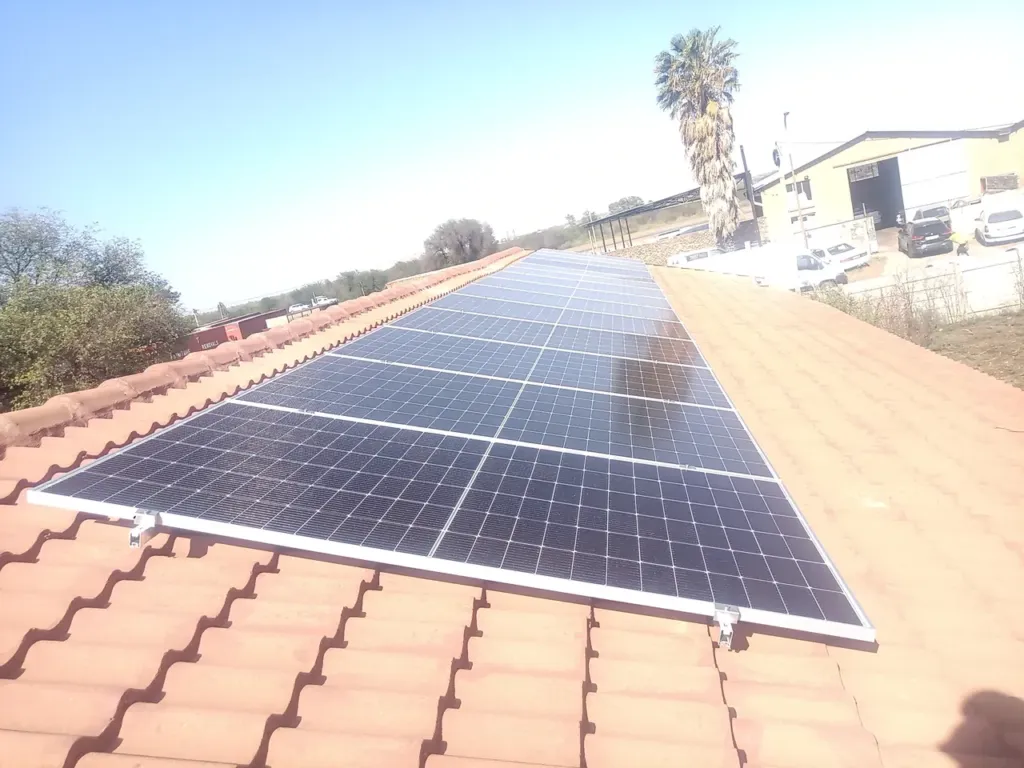
We have done this before. EFJS Printing runs 27 x 550 W panels with a 30 kW FoxESS inverter and a 12 kWh battery, and it paid back its investment in 2.5 years. Every model is checked against the maker's datasheet.
And we can do the same for you.
The sections below explain how panels work, what tier 1 actually means, and how ZenSolar sizes a system for your property.
How solar panels actually work
A solar panel is built from silicon cells. Silicon is not a metal, it's a semiconductor, the same family of material used in computer chips, chosen for how it reacts to light.
When sunlight hits a cell, it knocks electrons loose inside the silicon. The cell has a built-in electric field that pushes those loose electrons in one direction, and that one-way push is an electric current: direct current (DC), the same kind a car battery makes.
Wire enough cells together and you get a panel. Wire enough panels together and you get an array, making DC power whenever light falls on it. A home or business runs on alternating current (AC), so an inverter converts that DC power into the AC power your lights, plugs and machines use. See Solar Power Inverters for how that conversion works.
Light in, electrons moving, DC current out, converted to AC. No moving parts, which is a big part of why panels last as long as they do.

What "tier 1" actually means, and the six brands ZenSolar fits
"Tier 1" sounds like a quality grade. It isn't. It comes from BloombergNEF, a research firm that tracks which panel makers have had panels used on projects banks agreed to finance without extra security. A maker makes that list because banks trust it, not because a lab tested and ranked its panels. BloombergNEF says so itself: the list is not a recommendation, and should not be used as a measure of quality.
ZenSolar fits tier 1 panels only, from six makers: Canadian Solar, JA Solar, LONGi, Jinko, Trina and Aiko.
Did you know? Cheap panels lose 15% of output in 5 years, against under 5% for tier 1.
What to check on a panel
| Point | What it means for you |
|---|---|
| Tier 1 by BloombergNEF's list | Banks have trusted these six makers' panels enough to finance real projects with them. |
| Datasheet checked | ZenSolar checks efficiency, heat loss, degradation and warranty terms on every model it fits, not just the brand. |
| Dust | Output loss is gradual. A dusty inland site loses more between rains than a coastal one, but it is not a sudden failure. |
| Coastal salt | Some models are certified against salt mist (IEC 61701). On the coast, ask which exact model in your quote carries it. |
| Big motors starting | Panels alone were never meant to run big motors from a dead stop. Your inverter and battery handle the start-up surge. |
Mono or bifacial: which fits your roof
Almost every panel on a roof today is monocrystalline. PERC, TOPCon and back contact are different ways of building a monocrystalline cell, each a step toward less power lost to heat and higher efficiency. Polycrystalline, once the cheaper option, is old technology now, and ZenSolar does not fit it.
A monofacial panel only makes power from its front face. A bifacial panel has glass on both sides, so its rear side can pick up light too, usually reflected off whatever surface sits underneath it.
| Where it's fitted | Best fit | Why |
|---|---|---|
| Pitched home roof (tile, IBR, corrugated) | Monofacial (PERC, TOPCon or back contact) | The panel sits flush and close to the roof, so there's little reflected light for a bifacial rear side to use |
| Flat roof, light coloured membrane | Bifacial | Panels tilt above a pale surface, giving the rear side something to reflect off |
| Carport | Bifacial | Mounted high and open underneath, so light reaches the rear side freely |
| Ground mount | Bifacial | The surface below can even be chosen to reflect more light back up |
How much extra a bifacial panel gives back depends entirely on what's underneath it, never a fixed number. Jinko's own datasheet says its bifacial panel's power "increases 5 to 25% generally." Trina's own datasheet states its bifacial gain at "10 to 20%, depending on albedo" (albedo just means how much light a surface reflects). Both makers tie the figure to the ground below, not a promise for every roof.
Heat cuts panel output, here's the real number
Every panel loses some power as it heats up. This is called its temperature coefficient, stated on every maker's datasheet as a percentage of power lost per degree Celsius above 25°C, the temperature panels are tested at in the lab.
A typical tier 1 panel's temperature coefficient sits around -0.26% to -0.35% per degree C. Take a mid-range figure of -0.35% per degree C. On a hot Highveld or Free State roof, a panel's cells commonly run around 40 degrees C hotter than that 25°C lab figure. That's cell temperature, not the air temperature on a weather app, the actual heat of the cell itself, sitting close to a dark roof in full sun. Do the maths: 0.35 x 40 = 14. That panel is making about 14% less power than its rating suggests, purely from heat.
This is why temperature coefficient matters more in Gauteng and the Free State than the headline efficiency number does. A slightly less efficient panel with a better (lower) temperature coefficient can out-produce a higher-rated panel once both are baking on a real roof in January.
Panel wattage and how many fit your roof
Example only, your numbers will differ. Here's the maths: take your home or business's average daily electricity use in kWh, divide it by your city's daily solar yield (PVOUT), and that gives you the system size, in kWp, you'd need.
Say a site uses 30 kWh a day. Using a 550 W class panel (Canadian Solar's HiKu6, 2278 x 1134 mm, about 2.58 m² per panel, weighing 27.6 kg), here's how that plays out in five cities.
| City | Daily use (example) | Daily solar yield (PVOUT) | System size needed | Panels needed | Roof area needed |
|---|---|---|---|---|---|
| Johannesburg | 30 kWh | 4.9 kWh/kWp | 6.1 kWp | 12 | about 31 m² |
| Pretoria | 30 kWh | 4.9 kWh/kWp | 6.1 kWp | 12 | about 31 m² |
| Cape Town | 30 kWh | 4.8 kWh/kWp | 6.3 kWp | 12 | about 31 m² |
| Durban | 30 kWh | 4.1 kWh/kWp | 7.3 kWp | 14 | about 36 m² |
| Bloemfontein | 30 kWh | 5.2 kWh/kWp | 5.8 kWp | 11 | about 28 m² |
These are yearly averages. Winter changes the picture in some cities: Cape Town's June yield drops to about 3.0 kWh per kWp a day, while Johannesburg's clear winter skies hold at about 5.0. ZenSolar's design checks the worst month for your city, not only the average.
Weight adds up too: about 10.7 kg per m² for the panels alone (27.6 kg over 2.58 m²), plus roughly 4 kg per m² more for mounting rails and clamps. That's exactly why every ZenSolar job gets a structural engineer's sign-off before installation, not a rule of thumb.
Real job: EFJS Printing needed 14.85 kWp: 27 panels of 550 W each, paired with a 30 kW FoxESS inverter and a 12 kWh battery. It paid for itself in about 2.5 years. "ZenSolar was excellent in all that they did. The installation at my Printing Shop and home was done to the highest standard." Bernard Synman, Director, EFJS Printing.
How many panels does it take to refill a battery?
Example only, your numbers will differ. Say you're running a 5 kWh battery and want it refilled by the panels alone within about 4 hours of good sun. That's 5 kWh divided by 4 hours, or about 1.25 kW of panels feeding it, roughly three 550 W panels. Add in whatever else the property is using at the same time, and the real number moves. See Solar Power Backup for how ZenSolar sizes a battery from your real loads.
Matching panels to your FoxESS or Sigenergy inverter
Panels are wired together in a string, and a string's total voltage has to sit inside the inverter's MPPT window, the voltage range it can track and use. Get it wrong and the inverter either can't use the string properly or won't accept it at all. This is a design job, done in house by ZenSolar.
One thing catches people out: a panel's voltage rises when it's cold. A string sized only for a hot afternoon can push closer to an inverter's maximum voltage limit on a cold winter morning, before the sun has warmed the panels up. ZenSolar's design accounts for that swing, not just a panel's rated voltage on a datasheet.
| Inverter | Phase | MPPT trackers | MPPT voltage window | Max. DC input | Max. current per MPPT |
|---|---|---|---|---|---|
| FoxESS H1 G2 | Single | 2 | 80 to 550V | 600V | 16A |
| FoxESS KH | Single | 3 or 4 | 80 to 500V | 600V | 16A |
| FoxESS H3 Pro | Three | 3 (6 strings) | 150 to 850V, narrower at full load | 1000V (950V operating) | 32A |
| Sigenergy SigenStor, single phase | Single | 2 to 4 | 50 to 550V | Set in design | 16A |
| Sigenergy SigenStor, three phase | Three | 2 to 4 | 160 to 1000V | Set in design | 16A |
See Solar Power Inverters for the full sizing method and the South African rules that apply to every grid-connected system.
Not sure how many panels your roof needs?
Get your property assessedDegradation and warranties, from the makers' own numbers
A product warranty covers manufacturing defects and workmanship. A performance warranty covers how much power a panel is still expected to make after years of use, as a percentage of its original rating. Both come from the panel maker, not from ZenSolar.
ZenSolar's own 10-year swap-out warranty covers your inverter and battery, not panels. Panels carry the maker's own product and performance warranties instead, both usually running well past 10 years, as below. See Installation, Monitoring and Long-Term Performance for how long every part of your system lasts, and what the swap-out warranty covers in full.
Models compared: Canadian Solar HiKu6, JA Solar DeepBlue 3.0, LONGi Hi-MO X10 Guardian, Jinko Tiger Neo 72HL4, Trina Vertex N TSM-NE19R, Aiko Neostar 3P60, one monofacial rooftop model per brand, from each maker's own current datasheet.
| Brand | Cell type | Power range | Efficiency | Temp. coefficient | Degradation, year 1 then per year | Performance warranty | Output at end of warranty | Product warranty |
|---|---|---|---|---|---|---|---|---|
| Canadian Solar | Mono PERC, half-cut | 535 to 560 W | up to 21.8% | -0.34%/°C | 2%, then 0.55%/yr | 25 years | 85% | Varies by market* |
| JA Solar | Mono PERC, half-cut | 540 to 565 W | up to 21.9% | -0.35%/°C | 2%, then 0.55%/yr | 25 years | 85% | 12 years |
| LONGi | Back contact | 535 to 560 W | up to 24.8% | -0.26%/°C | under 1%, then 0.35%/yr | 30 years | 89% | 15 years |
| Jinko | N-type TOPCon, half-cut | 580 to 605 W | 22.45 to 23.42% | -0.29%/°C | 1%, then 0.40%/yr | 30 years | 87% | 12 years |
| Trina | N-type i-TOPCon, half-cut | 615 to 630 W** | 22.8 to 23.0% | -0.29%/°C | 1%, then 0.40%/yr | 25 years | 89% | 12 years |
| Aiko | N-type all back contact | 530 to 555 W | 23.9 to 25.0% | -0.26%/°C | 1% or less, then 0.35%/yr | 30 years | 89% | 25 years |
* Canadian Solar's product warranty varies by market and datasheet version, confirmed at quote stage. ** Trina's family runs 615 to 650 W; 615 to 630 W is the closest match to the other panels here.
Figures above are each maker's own, for one rooftop model per brand. ZenSolar confirms the exact model in your quote. No prices are shown here, your quote covers that.
Businesses can also ask about Section 12B, a tax write-off on solar equipment: see Finance and Project Enablement.
Roof weight and your roof warranty
A 550 W class panel weighs roughly 16 to 34 kg depending on the maker and size, adding real weight to a roof, on top of the mounting rails and clamps that hold it down. That's why ZenSolar's mounting method is designed to protect your existing roof warranty, and why every job gets sign-off from a structural engineer before installation starts, confirming your roof can carry it safely. See Installation, Monitoring and Long-Term Performance for the full lifespan of every part of your system.

Does one bad panel stop the whole system?
It can. On normal panels, a string runs only as well as its weakest panel, so one shaded or damaged panel can pull down every panel on that string. Aiko panels have a built-in optimizer, so a shaded Aiko panel does not drag its string down. A panel that fails completely, or a wiring fault, can stop its string until it is found and fixed. See Installation, Monitoring and Long-Term Performance for the full explanation.
Cleaning your panels
Dust cuts output gradually, and rain washes off a lot of it on its own. Where dust builds up faster than rain can manage, a gentle rinse with water, no harsh chemicals or abrasive tools, and real care around height and live electrical equipment, protects a panel's surface. This is general information, not a ZenSolar service or a fixed schedule. See Installation, Monitoring and Long-Term Performance for why cleaning and checks matter, and what maintenance can include, which depends on the options you choose.
Tier 1 only, checked against the datasheet
Six named makers, every model checked for efficiency, heat loss, degradation and warranty before it goes on your roof, which means you buy on the numbers, not the brand name.
Matched to your roof and your inverter
Panel type, string design and mounting are all worked out for your specific property, not picked off a generic spec sheet, which means your panels and inverter work well together.
Your roof warranty, protected
ZenSolar's mounting method and a structural engineer's sign-off on every job protect the roof you already have, which means your existing roof warranty stays safe.
Backed by the maker, backed by ZenSolar
Panels carry their own maker's product and performance warranty; your inverter and battery carry ZenSolar's 10-year swap-out warranty, which means every part has someone standing behind it.
A shaded panel can hold back its string
On normal panels a string runs only as well as its weakest panel. Aiko panels have a built-in optimizer.
How we get you the right panels
1
Book your free energy assessment
We look at your property, your roof and your real electricity use, so we know what your system actually needs.
2
Get your report and design
Your report shows the recommended system size, equipment list and payback time, with panels matched to your roof and inverter. See Energy Audit and Design for what the assessment covers.
3
We install and maintain your system
Installed by our team and preferred, vetted installers approved by the brands, with CoC and SSEG application handled for you. Maintenance depends on the options you choose. Then your panels start making power on a roof that is signed off and compliant.
How is this different from a cheap panel deal?
With us
- Tier 1 panels only, from six named makers, checked against the datasheet
- Matched to your roof type and your FoxESS or Sigenergy inverter
- Roof warranty protected, with a structural engineer's sign-off on every job
- CoC and SSEG application handled for you, fees and meter costs included
- The maker's own product and performance warranty, backed by ZenSolar's design and install
With them
- Unknown tier, no datasheet check
- Cheap panels can lose 15% of output in 5 years, against under 5% for tier 1
- No inverter or roof matching
- Paperwork left to you
- No one local to call once it's on the roof
Frequently asked questions
A panel from a maker banks have trusted enough to finance large solar projects with, per BloombergNEF's own list. It's a sign of financial track record, not a lab-tested quality grade. ZenSolar fits tier 1 panels only, from six makers: Canadian Solar, JA Solar, LONGi, Jinko, Trina and Aiko.
Tier 1 tells you banks trust the maker, not that every model is the best fit for your roof. ZenSolar also checks each model's own datasheet: efficiency, heat loss, degradation and warranty, before it goes on a quote.
Monocrystalline cells are cut from a single silicon crystal, giving higher efficiency and a better temperature coefficient. Polycrystalline cells, cheaper but less efficient, are now old technology. ZenSolar fits monocrystalline panels only.
Not automatically. A bifacial panel makes more power only with a reflective surface underneath it. On a dark, low pitched roof it gets little to no extra benefit. It depends entirely on where it's fitted.
Bifacial panels do best on flat roofs with a light coloured surface, carports and ground mounts, where the rear side can pick up reflected light. A pitched home roof usually suits a monofacial panel better.
It depends on your daily electricity use and your city's sun hours. As a rough guide, a home using 30 kWh a day in Johannesburg would need around 12 panels of 550 W each. Your free energy assessment works out the real number.
A single panel can make enough power on a sunny day, but only while the sun is on it, with nothing stored for later. A proper system, sized with a battery and inverter, keeps a fridge running around the clock. See Solar Power Backup.
Tier 1 panels are commonly backed by a 25 to 30 year performance warranty, and keep producing usable power well after that, at a slightly reduced output. That's separate from ZenSolar's 10-year swap-out warranty on your inverter and battery.
Panels only make power while the sun is up, and heat cuts output too, sometimes by around 14% on a hot Highveld roof. That's why the panel, inverter and battery all need to be matched properly, not bought as separate boxes.
It can hold back its string. On normal panels a string runs only as well as its weakest panel, and Aiko panels have a built-in optimizer. A panel that fails completely, or a wiring fault, can stop its string until it is fixed.
Dust cuts output gradually, and a gentle rinse can help. Avoid harsh chemicals and abrasive tools, and take care working at height near live electrical equipment. This is general guidance, not a ZenSolar service.
Yes. Every panel has a temperature coefficient, a percentage of power lost per degree above 25°C. On a hot Highveld or Free State roof, that can add up to around 14% less power, which is why this figure matters more than headline efficiency.
Not ready for a full assessment? Contact us or see how panels pair with Solar Power Inverters and Solar Power Backup.