
EV charger installation, powered by solar
Charge company cars, a depot or a home EV from your own solar and battery system, installed and matched to your property.
Start an assessmentCharging vehicles without a plan costs more than it should
Does this sound familiar?
An EV charger is one more load on the property. It works best designed into the system from the start, not bolted on afterwards.
We design EV charging into your solar and battery system, business first
New energy vehicle sales in South Africa, across electric, plug-in hybrid and hybrid models, rose 7.1 percent in 2025 to 16,716 units. ZenSolar designs charging into the system from the start, for a depot of company cars, staff and visitor parking at an office, or a car at home.
There are two ways ZenSolar fits EV charging: built into the Sigenergy SigenStor stack as a DC charging module, or as a separate AC charger fitted beside a FoxESS or Sigenergy system. Either way, the system's battery and energy management decide when the car actually charges, and you can watch it happen in the app. The newer SigenStor Neo charges a car through a separate AC charger only.
ZenSolar's own FoxESS system at EFJS Printing, a 30 kW inverter with a 12 kWh battery, paid for itself in about 2.5 years. That job did not include EV charging, but it is the same careful sizing that goes into every system ZenSolar designs.
And we can do the same for you.
ZenSolar designs every system in house, matched to your property, sized to your panels, battery and vehicles. See Commercial Solar and Residential for how a whole system is designed either way.
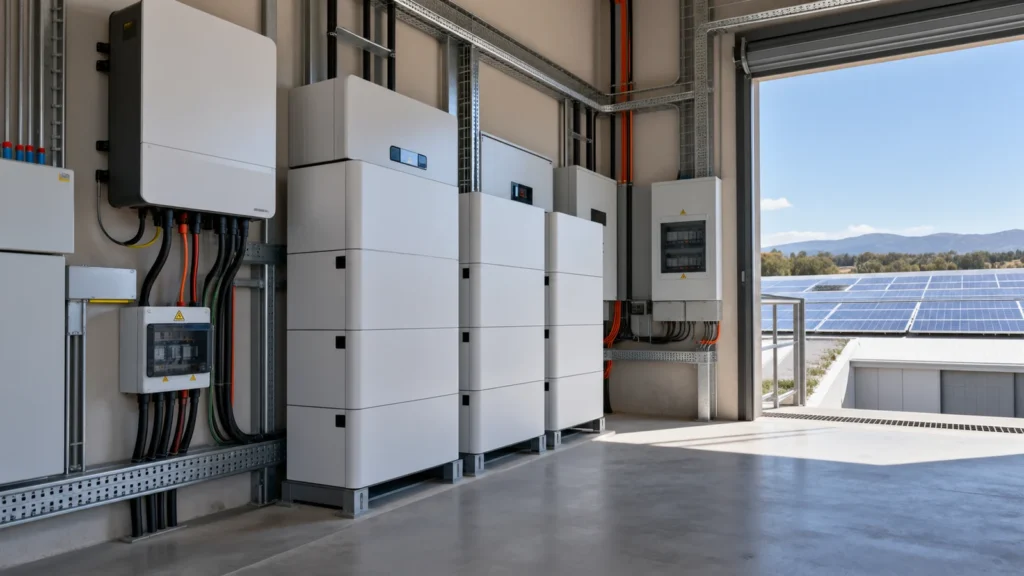
The Sigen EV DC charging module, built into the SigenStor stack
The module runs at 12.5 kW as standard, upgradeable to 25 kW, with a CCS2 connector, and draws power straight from the stack's own solar and battery on DC.
Charging happens without converting the stack's DC solar and battery power to AC and back to DC inside the car, and Sigenergy states it can add up to 150 km of driving range in an hour at its full 25 kW.
A business running a small fleet from one site gets one system that stores solar, gives it control over its own supply and charges the cars, instead of three separate boxes to manage. At home, one car charges straight from the roof and the battery, with no separate charger to install.
The module also supports vehicle-to-home and vehicle-to-grid charging, sending power back out of the car's own battery.
Where the car itself supports it, the car's battery can add to the site's stored power, or send power back to the grid at busy times.
Sigenergy is clear that this depends entirely on the car, not the charger: there is no published list of which cars qualify, and the feature can be upgraded later as standards catch up. Ask us to check your vehicle before counting on it.
A separate AC charger, fitted beside either system
The Sigen EV AC Charger runs at 7, 11 or 22 kW, single or three phase, and can switch between single and three phase automatically so it does not overload the supply. FoxESS's own EV chargers run similar power levels: 7.3, 11 or 22 kW on the A series, 7.3 or 11 kW on the L series.
Either charger fits onto a FoxESS or Sigenergy system that is already installed, with no DC module required, and both include a solar surplus mode that charges the car mainly from power your panels are already making.
A depot or office can fit several AC chargers across a parking area, one per bay, without redesigning the main solar and battery system each time a vehicle is added. At home, one AC charger added beside an existing inverter charges the car without touching the rest of the system.
A FoxESS charger pairs with a FoxESS system such as the FoxESS 30 kW three-phase hybrid inverter on a business site, or the FoxESS 10.5 kW single-phase hybrid inverter at home. See the full range on FoxESS technology and Sigenergy technology.
The Sigenergy DC module vs a separate AC charger
| Power | Where it fits | Which system it needs | Best for | Phase | |
|---|---|---|---|---|---|
| Sigen EV DC Charging Module | 12.5 kW, upgradeable to 25 kW | Built into the SigenStor stack itself | A SigenStor system with the DC EV module fitted | A home or small business charging one or two cars straight from the stack | Not phase-dependent, feeds the car on DC |
| A separate AC charger (Sigen EV AC Charger or FoxESS EV charger) | 7, 11 or 22 kW | A separate unit near the parking area, wired to the DB board | Any FoxESS or Sigenergy system already installed | A depot or workplace charging several vehicles, or any site adding charging after the system is in | Single or three phase, matched to the charger and the site's supply |
Neither is simply better. A business or home already choosing a new Sigenergy system can build the DC module in from the start; a site with an existing FoxESS or Sigenergy system, or one that needs several charge points, fits a separate AC charger instead.
Charger types: 7 kW, 11 kW, 22 kW and DC
| Charger type | Power | Phase | What actually limits charging speed |
|---|---|---|---|
| Single-phase AC | 7 kW (7.3 kW on FoxESS) | Single phase | The car's own onboard charger. Some electric cars sold in South Africa take about 7 kW on AC; many take 11 kW. |
| Three-phase AC | 11 kW | Three phase | Needs a three-phase supply and a car whose onboard charger accepts 11 kW. |
| Three-phase AC | 22 kW | Three phase | The fastest AC most home and business chargers offer. Still capped by the car's onboard charger; only some cars sold in South Africa can use the full 22 kW. |
| DC | Up to 25 kW (Sigenergy's own DC EV module) | Feeds the car's battery directly, not tied to a phase | Bypasses the car's onboard AC charger completely. Needs a car with a DC charging inlet, and only works through the module built into the SigenStor stack. |
A charger rated higher than a car's onboard charger does not charge that car any faster. This is true of any charger, from any maker: the limit sits inside the car, not the charger.
The battery and energy management decide when your car charges
Sigenergy's PV Surplus Charging mode ranks the car against the rest of the site's loads and can be set to charge mainly from solar power during the day. Battery Boost Charging can add power from the site's own battery to speed up a charge, and Sigen AI Mode times charging around your tariff, cheapest or greenest hours first.
The system, not a plug-in timer, decides whether the car charges from solar, from the battery, or from the grid, and when.
A business charging a fleet overnight can draw on the battery or cheaper night-time power, then top up from solar the next afternoon before the cars go out again. At home, a car charging during the day can run mostly on solar; charging overnight draws on the battery or the grid instead, since there is no sun to use. See the full picture on Energy Management, and how a battery works more generally on Solar Power Backup.
Monitoring in the app
mySigen shows where the site's stored energy actually came from, solar, battery, EV charger, generator or grid, updating roughly every 10 seconds. FoxCloud shows real-time and historical production and use by day, week, month and year.
You see exactly how much of a car's charge came from solar and how much came from the grid, without visiting the site.
A fleet manager can check charging at a depot from head office, and a homeowner can see the same for their own car, on the same app that already shows the rest of the system.
Which EV charging setup fits your site?
| Property or site | Typical need | What usually fits |
|---|---|---|
| Depot or fleet of company cars | Several vehicles charging overnight or between routes | Several AC chargers (11 kW or 22 kW three phase), sized to the depot's overnight window |
| Office with staff and visitor parking | A few vehicles charging during the working day | One or more AC chargers with solar surplus mode; daytime charging fits solar best |
| Shop or small business | One or two company or owner cars | One AC charger, 7 kW single phase or 11/22 kW three phase depending on the site's supply |
| School or similar site | Staff and visitor cars during the day | AC chargers added alongside the existing system, daytime surplus charging |
| Large home, two cars | One or two cars, at least one charging overnight | A Sigenergy system with the DC module built in, or a second AC charger |
| Small home, one car | One car, charging overnight or on weekends | A 7 kW AC charger, or the DC module where a new Sigenergy system is being installed anyway |
This is a starting guide. The free energy assessment measures your property's real usage and vehicles and sizes the actual system.

Not sure whether your site needs an AC charger or the DC module?
See which one fits your propertyExample numbers only: charging a small fleet from solar
This uses example figures to show the method, not a real client's numbers. The free energy assessment works out your actual vehicles, usage and system size.
Five company cars, each driving 80 km a day, 22 working days a month, at 16 kWh per 100 km, a typical figure for a small electric car: 5 x 80 km x 22 days = 8,800 km a month.
Energy needed: 8,800 km / 100 x 16 kWh = 1,408 kWh a month.
At Eskom's Businessrate tariff, about R2.79 per kWh including VAT (2026/27), that energy would cost about R3,933 a month bought from the grid.
At about 5 kWh per kWp of panels a day, a typical South African solar yield, that is 1,408 kWh / 30 days / 5 kWh per kWp = about 9.4 kWp of extra panels to cover it from the sun instead.
A fleet like this charges mainly overnight, back at the depot, when there is no sun. That is where the battery and energy management earn their keep: storing the day's solar to use once the cars are plugged in, and drawing on the grid, at the cheapest time available, for whatever is left. Businesses adding several chargers at once do not need to buy the system outright: a PPA (usually 10 years or more, can be shorter) or rent to own (3 to 7 years, up to 15) spreads the cost; see Finance for how ZenSolar structures these.

Example numbers only: charging one car at home
Again, this is an example only. 1,500 km a month, a common round number for a commuting household, at the same 16 kWh per 100 km: 1,500 km / 100 x 16 kWh = 240 kWh a month.
At Eskom's Homepower tariff, about R3.22 per kWh including VAT (2026/27), that is about R773 a month bought from the grid.
At about 5 kWh per kWp of panels a day, 240 kWh / 30 days / 5 kWh per kWp = about 1.6 kWp of extra panels, roughly three 550 W panels, to make that much energy over a month.
The plain rule behind both examples: energy from panels you already own adds no per-kWh bill. A car that charges at night needs the battery or the grid, since the panels are not making power in the dark. Daytime charging, at a workplace or a home where someone is around during the day, fits solar best.

The South African rules for an EV charger
1
Get a Certificate of Compliance. Any new electrical circuit, including one for an EV charger, needs a CoC issued by a registered electrician under South Africa's SANS 10142-1 wiring rules, confirming the installation is safe.
2
Register the solar system. SSEG registration is about the solar system's own connection to the grid. If a car will send power back to the grid through a bi-directional charger, we check what your supplier needs as part of the design.
3
Check the site's supply before adding several chargers. A depot or office fitting more than one charger at a time should confirm its three-phase supply can carry the load, which the free energy assessment checks as part of sizing the system.
ZenSolar's promise here is the same as on every system it fits: CoC and SSEG application handled for you.
How we get your EV charging right
1
Book your free energy assessment
We look at your vehicles, your daily driving, your property and your biggest loads, so we know what your system actually needs to charge.
2
We size the charging into your system
A DC module built into a new Sigenergy stack, or an AC charger fitted beside a FoxESS or Sigenergy system, sized to your vehicles and your site's supply.
3
Installed and monitored
Your charger is on and you see in the app how much of each charge came from solar. Installed by our team and preferred, vetted installers approved by the brands, with the CoC and SSEG paperwork handled for you and a 10-year swap-out warranty on the inverter and battery.
A real job: EV charging
ZenSolar has already fitted solar powered EV charging for a client. The free energy assessment sizes yours the same way: from your vehicles, your driving and your site.
How is this different from buying an EV charger online?
With us
- Matched to your property, vehicles and existing system after a free energy assessment
- FoxESS and Sigenergy equipment only, with ZenSolar's 10-year swap-out warranty on your inverter and battery
- We install and maintain your system
- CoC and SSEG application handled for you
With them
- Guess whether the charger suits your existing inverter and supply yourself
- A basic timer, with no solar surplus charging logic
- Self-install and hope it is compliant
- No help with the paperwork
Frequently asked questions
Yes. A car can charge straight from your panels during the day, from a battery once the sun goes down, or from the grid when neither is available. ZenSolar sets this up either as a Sigen EV DC Charging Module built into a Sigenergy battery stack, or as a separate AC charger fitted beside a FoxESS or Sigenergy system, with solar surplus charging built in.
It depends on where the power comes from. Grid power costs whatever your Eskom or municipal tariff charges per kWh; energy from solar panels you already own adds no per-kWh bill at all. In our own example, 1,500 km a month at a typical small car's consumption comes to about R773 bought from the grid, or about 1.6 kWp of extra panels covering the same energy from the sun.
It depends on your supply and how many vehicles you are charging. A single 7 kW charger works on single phase, which suits most homes and a single company car. Businesses charging several vehicles, or wanting the faster 11 or 22 kW tiers, generally need a three-phase supply. Check your DB board, or ask us during the free energy assessment.
Yes, and it is what this page is about. A depot or office fits AC chargers across its own parking area, sized to its own vehicles, and links them to the site's solar and battery so charging happens on solar where possible and on stored or grid power the rest of the time. No public charging network is required.
The DC module is built into the SigenStor battery stack itself and charges the car straight from solar and battery power on DC, up to 25 kW. A separate AC charger, from Sigenergy or FoxESS, is its own unit fitted beside an existing system, running at 7, 11 or 22 kW. Neither is simply better; it depends on your system and site.
It can be, especially charging a fleet overnight when there is no sun. The battery and energy management decide this for you, charging the car from stored solar first and topping up from the grid only for what is left. It is a genuine trade-off against keeping some battery capacity in reserve for the rest of the property.
Yes. Any new electrical circuit, including one for an EV charger, needs a CoC from a registered electrician confirming the installation meets South Africa's wiring rules. It is the same requirement as any other new circuit added to a property, not a separate EV-only process.
SSEG registration is about the solar system's own connection to the grid, and ZenSolar handles that application for you. A normal charger that only takes power is a load, like any other appliance. If a car will send power back to the grid through a bi-directional charger, we check what your supplier needs as part of the design.
Usually yes. A separate AC charger, from FoxESS or Sigenergy, fits beside a FoxESS or Sigenergy system that is already installed, without needing to redesign it. A Sigenergy DC module has to be built into the SigenStor stack itself, so it generally suits a new Sigenergy system rather than one already on the wall.
Usually not at the full 22 kW. The car's own onboard charger sets the real limit, and many electric cars sold in South Africa take 11 kW or less on AC, whatever the charger can supply. A 22 kW charger is still useful on a site with several cars, or one that may fit a faster-charging car later.
Not ready for a full assessment? Contact us and we will answer your questions first, or see the full picture on Energy Management.