
Not sure how to pay for solar?
There is more than one way to pay for solar. There is also a lot of work between "yes" and switch-on. We help with both. You see who owns the system, who can claim the tax allowance, and what we handle for you, before you choose.
Start my free energy assessment Talk to a Solar SpecialistConfused about how to pay for solar? You are not alone.
Does this sound familiar?
We believe you should see who owns the system, who claims the tax allowance and what it costs, before you choose. Here is the full picture.
We help South African homes and businesses choose the right way to pay for solar
Most people are shown one product, and nobody explains who owns the system or who claims the tax allowance.
ZenSolar designs every system. We also work with major funders, so you can pay in one of four ways: cash, rent to own, a lease, or a Power Purchase Agreement (PPA) if you are a business. No route is best for everyone. The right one depends on your cash flow, your tax position, and how long you plan to stay in the property.
Every finance talk starts with the same free energy assessment. We review your bill and your usage, including demand charges. For bigger sites, we can log your usage on site first. You get a report. It shows your recommended system size, the equipment list, and how long the system is likely to take to pay for itself.
Then we handle the project work that gets you to switch-on. That is the "project enablement" part of this page.
We have done this before. EFJS Printing paid back its investment in 2.5 years.
And we can do the same for you.

The four ways to pay, in short
| Route | How it works | What it means for you |
|---|---|---|
| Cash | You own the system from day one, and you can normally claim Section 12B if your business owns and uses it. | The most money upfront, and no term to run. |
| Rent to own | You pay the system off in instalments. The term runs from 3 years up to 15 years, depending on the deal size and your company's history. | The funder owns it until the last payment, then it is yours. |
| Lease | You pay for the use of the system, and the funder owns it. | Owning it, or buying it out, is possible with some funders, not with others. |
| PPA, for businesses only | The funder owns and runs the system. You pay for the solar power you use, per kWh, at a price that is agreed up front and goes up each year. | No upfront cost for the system. A PPA usually runs 10 years or more, and can be shorter. |
Want all four side by side in one table, with bill bands and a list of questions to ask? See finance options. Section 12B is a tax matter, not something ZenSolar can decide for you, so ask your tax adviser before you choose. Want a rough number first? Try the finance calculator.
Whichever way you pay, maintenance depends on the options you choose.
Finance available through South Africa’s leading banks


When a PPA suits your business, and when buying suits you better
A PPA usually suits you if
Buying (cash or rent to own) usually suits you better if
Not sure which one fits? A free energy assessment gives you a real system size, an equipment list and a payback time first. Then you choose with real numbers, not a guess.
Section 12B, in plain words
Under Section 12B, the owner of a solar system, who brings it into use in their own business, can normally write off the cost. Only the owner can claim it, not a tenant or a customer who is simply using someone else's equipment. Ask your tax adviser how this applies to your contract.
For most business solar systems (there is a size limit, so ask your tax adviser), the full cost can be written off in the year the system is brought into use. The system does not have to be new. There was also an enhanced 125% allowance, Section 12BA, for new and unused systems. It ended on 28 February 2025 and was not renewed. Any system brought into use after that date uses the ordinary allowance above.
Who can claim it, route by route
Example only. South African company tax is currently 27%. A 100% Section 12B allowance can reduce a company's taxable income by the full cost of a qualifying system in year one. At 27% company tax, that can cut the tax bill by up to 27% of the qualifying cost. This only applies if the business owns the system, uses it in its own trade, and has enough taxable profit that year to use the deduction against. It lowers the tax you owe. It is not a cash refund.
None of this is tax advice. Every business is different, so ask your own tax adviser before you decide how to pay.
Demand charges and time of use: how solar and a battery help
Many business power bills carry two charges. One is for the energy you use, in kWh. The other is a demand charge. It is billed on the highest half hour of use in the billing period, not on your total use. So cutting that peak half hour matters as much as cutting your overall use.
Some tariffs also change by time of day. Peak hours cost the most. Standard hours cost less. Off-peak hours, mostly late at night, cost the least. Some tariffs change by season too. Common Eskom business tariffs include Megaflex, Miniflex, and Business Rate or Nightsave Business.
Solar helps in the day. A battery can charge from your panels, or at cheaper hours. It then lets you use that stored power at your priciest hours, instead of the grid. That can lower your demand charge and what you pay at peak times, without changing how your business runs. See energy management for how this works. No room for panels at all? Wheeling brings solar power from another site to you over the grid.
Project enablement: what we handle for you
Paying for the system is one part. Getting it cleared, signed off and switched on is the other. Here is what ZenSolar does, whichever way you pay.

A real business result: EFJS Printing
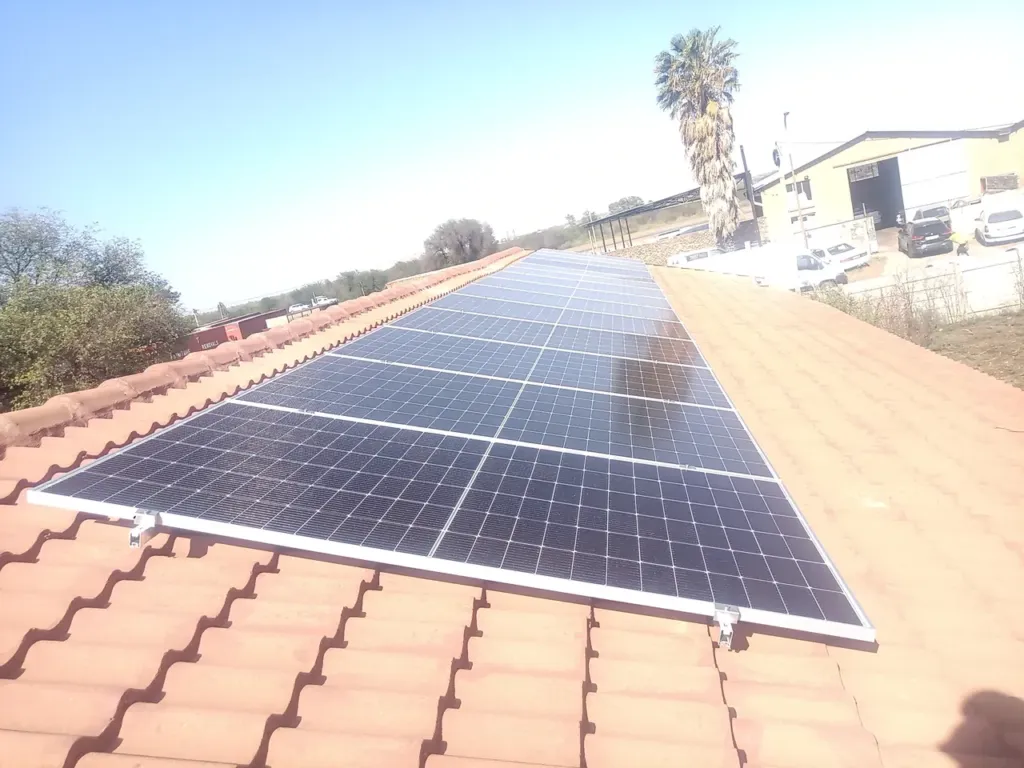
EFJS Printing fitted a 30 kW FoxESS inverter, a 12 kWh battery, and 27 x 550 W panels (14.85 kWp). The system paid for itself in about 2.5 years.
"ZenSolar was excellent in all that they did. The installation at my Printing Shop and home was done to the highest standard." Bernard Synman, Director of EFJS Printing.
No two businesses have the same numbers. A free energy assessment is how you get yours.
What you can expect from ZenSolar's finance and project enablement
Four honest ways to pay
Cash, rent to own, lease or PPA, set out plainly before you choose, which means you pick the route that fits you, not the one that is easiest to sell.
A real answer on tax
We show who can claim Section 12B on each route, which means you know your tax position before you sign. We always point you to your own tax adviser too.
Your numbers before any finance talk
Every job starts with a system size, an equipment list and a payback time, which means you choose how to pay based on your own numbers.
Paperwork handled for you
CoC and SSEG application handled for you. Fees and meter costs are already in your quote, which means no surprise compliance bill later.
Backed by a 10-year swap-out warranty
Every system we fit carries our 10-year swap-out warranty on the inverter and battery. The warranty does not depend on how you paid, which means a faulty inverter or battery is swapped out, however you paid.
Built on a real result
EFJS Printing's system paid for itself in about 2.5 years, which means you see a real job, not a projection.
From assessment to switch-on
1
Book your free energy assessment
We review your bill and your usage, including demand charges. For bigger sites, we can log your usage on site. The logger stays 1 to 2 weeks.
2
Get your report and choose how to pay
Your report shows your recommended system size, equipment list and payback time. Then you choose cash, rent to own, a lease, or a PPA if you are a business.
3
Installed, backed, and switched on
We install and maintain your solar system with swap-out warranties and smart automation. We handle your CoC and SSEG application, and you get pop-up notifications in the app once you are live. See what happens after switch-on on installation and long-term performance.
How are we different?
With us
- Four ways to pay, laid out plainly
- A plain answer on who can claim Section 12B, route by route
- CoC and SSEG handled, fees and meter costs in your quote
- One real result: EFJS Printing, not a promise
With them
- One product pushed, whether it fits or not
- Tax questions left for you to work out later
- Paperwork and fees that turn up after you sign
- Marketing numbers instead of a real result
Still have questions?
Four: cash, rent to own, a lease, and a Power Purchase Agreement (PPA) for businesses. Cash and rent to own end with you owning the system. With a lease, owning it at the end depends on the funder. With a PPA, you pay for the power, not the system. See finance options for the full comparison.
A PPA is for businesses only. You do not buy or finance the equipment. Instead, you pay for the solar power the system produces. The funder owns the system, usually for 10 years or more, though a shorter term is possible. See PPA for business.
Yes. The price is agreed up front, and it goes up each year by an amount set in your agreement. Ask your funder how the yearly increase is worked out, and get it written into your agreement.
On a PPA or a lease, the funder owns the system. On rent to own, the funder holds the system as security until the final payment, then it is yours. On a cash purchase, you own it from day one.
Rent to own runs from 3 years up to 15 years, depending on the size of the deal and your company's history. A PPA usually runs 10 years or more, though a shorter term is possible. See rent to own.
Buying out a PPA or a lease early, and owning the system at the end of a lease, are possible with some funders, not with others. Ask which of these your agreement allows before you sign.
The owner of the system, who uses it in their own business. With cash, you can normally claim it. Under a PPA, it is normally the funder. Under rent to own, it depends on how your agreement is structured. Under a lease, not you, because you do not own it, and under a plain lease the funder generally cannot claim it either. Ask your tax adviser about your own position.
Yes, for businesses. Under the ordinary Section 12B allowance, the owner can write off the full cost of a qualifying system in year one. The enhanced 125% allowance, called Section 12BA, ended on 28 February 2025. The old rebate for homeowners' panels only covered panels first brought into use between 1 March 2023 and 29 February 2024. That rebate has since closed.
VAT at the standard rate of 15% normally applies. If your business is a registered VAT vendor, ask your accountant about claiming it back.
A demand charge is billed on the highest half hour of use in the billing period, on top of the energy you use. Solar with a battery can help lower that peak, and what you pay at the priciest hours of the day.
We handle the free energy assessment and report, the design, a structural engineer's sign-off on every job, and your CoC and SSEG application. SSEG fees and meter costs are included in our quotes.
It depends on your usage, your bill, and how you choose to pay. EFJS Printing's system paid for itself in about 2.5 years. The only way to know your own numbers is a free energy assessment. It gives you a system size, equipment list and payback time before you commit.
Still have a question? Get in touch and we will answer it directly, or see everything ZenSolar offers on Services.