How a solar water heater actually works
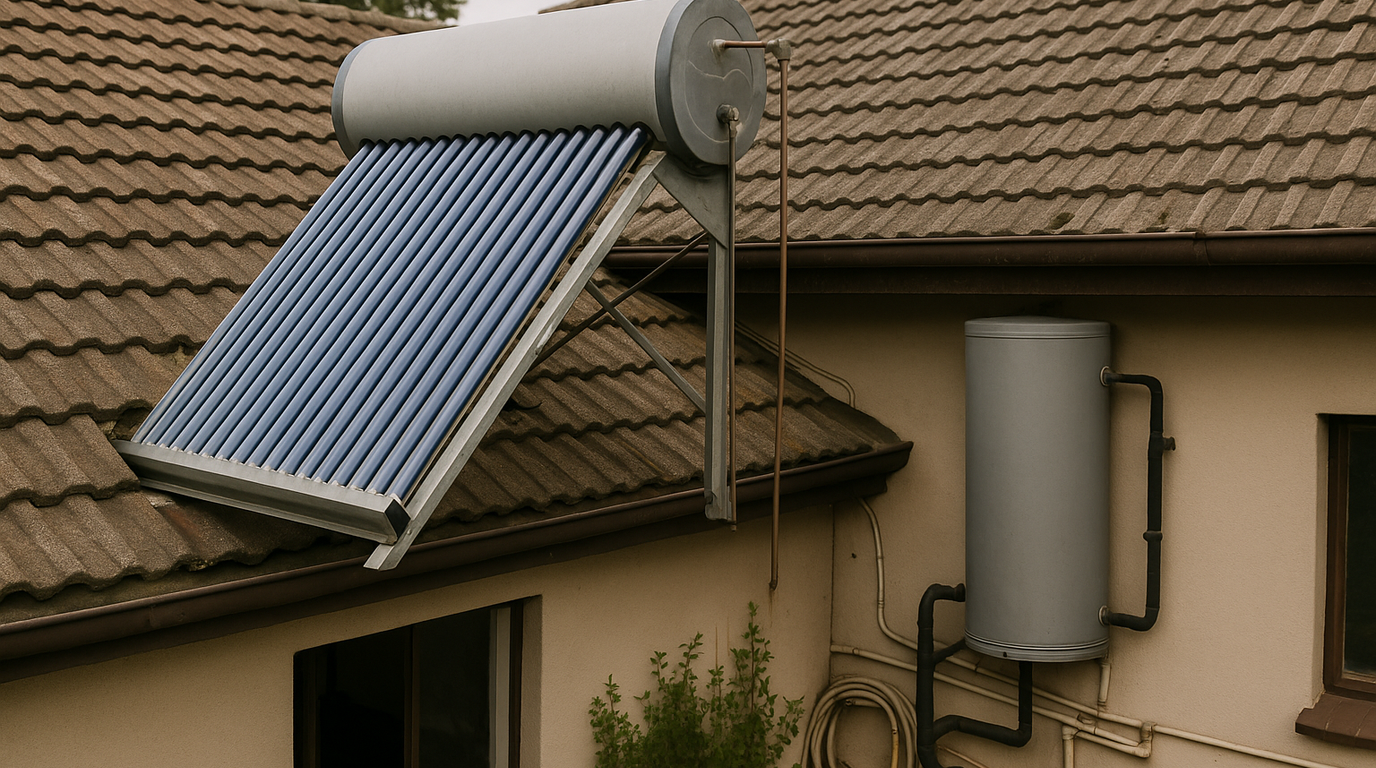
A solar water heater uses the sun to warm water in a collector panel on your roof, then stores that hot water in an insulated tank until you need it. When the sun cannot keep up, a backup electrical element switches on so you never run out.
South Africa’s installed renewable energy capacity is forecast to grow toward 32 GW by 2030, according to GreenCape, and solar water heating is one of the simplest ways a household can be part of that shift.
The collector, the tank and a small circulation loop do the real work. A controller or thermostat decides when the backup element comes in, and a pressure valve protects the system from steam if something goes wrong.
Direct versus indirect systems
In a direct system, the same water that comes out of your tap circulates through the collector and into the tank. It is simple, cheap and works well in areas where the water is fairly clean and the nights are mild.
An indirect system uses a separate heat-transfer fluid, usually a food-grade glycol mix, that circulates through the collector, picks up heat, and then passes that heat to the tank water through a heat exchanger. The extra loop matters in two situations: cold high-altitude towns where the collector can freeze overnight, and coastal or hard-water areas where scaling inside a direct collector would ruin it within a few years. Choose direct when your site is frost-free and your water is reasonably soft. Choose indirect when it is not.
The main types available in South Africa
Two collector designs cover almost every residential roof in South Africa. Both do the job, but they behave differently in winter, in shade, and on heavy roofs.
Flat plate collectors
A flat plate is a sealed, insulated box with a dark absorber plate under glass. Sun heats the plate, the plate heats the fluid, and the box keeps heat loss low. Flat plates are tough, last a long time and handle hail better than glass tubes. They are heavier per panel, so the roof must carry the load, and they lose more heat on cloudy days than evacuated tubes.
Evacuated tube collectors
An evacuated tube is a row of glass tubes, each one a double-walled vacuum flask with an absorber inside. The vacuum cuts heat loss almost to zero, so tubes work earlier in the morning, later in the afternoon and through cloud cover better than flat plates. They are lighter per square metre, but the tubes are breakable and have to be replaced individually if one cracks.
Sizing the system to your household
Sizing is where most solar water heaters quietly fail. A system that is too small leaves you reaching for the element on cloudy days, which kills the savings. A system that is too large costs more than it ever returns.
Tank capacity by household size
A rough guide is 50 litres per person for the first three people, then 30 litres per person after that. A family of four usually lives well with a 200-litre tank. A family of five or six usually wants 250 to 300 litres. Single people and couples often do better with a 150-litre tank or with retrofitting a PV diverter to their existing geyser instead.
Collector area and roof space
Most domestic systems need between 2 and 4 square metres of collector area. The roof must hold that weight, face north, and be clear of shade between about 9am and 3pm. Your installer measures usable roof space during the site visit, not from a satellite image, because nearby trees and taller buildings cast more shade than people expect.
What it costs and what it saves
The honest answer is that cost depends on tank size, collector type, roof complexity and how far the site is from the installer. The savings depend on how much hot water you actually use, your tariff, and how often the backup element kicks in.
Equipment and installation costs
A complete residential system, including the tank, collectors, mounting frame, plumbing, electrical backup element and labour, varies widely in price once you include installation and VAT. The wide range reflects tank size, collector type (flat plate versus evacuated tube), roof height and access, and whether you need an indirect system because of frost or hard water. Your quote will be specific to your roof.
Payback and what drives it
Typical payback on a correctly sized solar water heater runs roughly between four and eight years for a household using around 200 litres of hot water a day. Payback depends on tariff, consumption, system size and usage pattern, so two homes on the same street can see very different numbers. The national average electricity tariff rose by an average of 10% per year from 2014 to 2024, against inflation of 5.2% over the same period, according to the CSIR, which is why the case keeps getting stronger the longer the system lasts. Municipal electricity tariffs are also set to rise by an average of 9.01 percent from 1 July 2026, according to Eskom, adding further pressure on electric-only hot water costs.
Installation on a South African roof
Installation usually takes a day for a straightforward thermosiphon system and up to two days for a split, pump-assisted system. A good installer refuses to start until the roof, the orientation and the plumbing have all been checked on site.
North-facing placement and roof structure
Collectors want to face north, because we sit in the southern hemisphere, and they want a tilt angle close to your latitude for best year-round yield. East- or west-facing placements still work, just with lower output. The roof structure has to take the weight of a full tank, which is several hundred kilograms once it is full of water, so a tiled roof often needs additional bracing that a lightweight IBR roof does not.
Compliance and the Certificate of Compliance
Any new or altered electrical work, including the backup element circuit, needs a Certificate of Compliance from a registered electrician before the municipality will sign off the installation. The plumbing side has to meet SANS standards, which are the category benchmark for water installations. Your installer handles both and should hand you the CoC with the rest of the paperwork on completion day.
One note worth knowing: a solar geyser is not the same as using a solar PV system with a standard geyser element. The dedicated solar water heater puts the heat directly into the tank from the sun, while a PV diverter pushes surplus PV power into an ordinary geyser element. The dedicated system produces more hot water per square metre of roof. The PV diverter is cheaper if you already have panels and batteries.
Maintenance over the life of the system
A solar water heater is not maintenance-free, but the routine is short. Plan on a once-a-year check rather than monthly tinkering.
What the annual visit covers: the sacrificial anode in the tank, which protects the steel from corroding and usually needs replacing every three to five years; the pressure relief valve, which can seize if left untouched; the glycol level and condition on indirect systems, which drops a little each year; and a descale of the collector on direct systems in hard-water areas. Glass on flat plates and tubes on evacuated systems both want a wipe-down once or twice a year to keep output from drifting down.
When a solar water heater is the wrong call
A solar water heater is the wrong choice when the conditions on the roof do not match the system. Pushing on regardless usually means the system pays back over a much longer period, or never.
It is the wrong call when the household uses little hot water, say under 100 litres a day, because a smaller retrofit diverter on the existing geyser is cheaper. It is the wrong call when the roof is heavily shaded by trees or taller buildings for most of the day, because the collectors will not generate enough heat to make the install worth the spend. It is the wrong call when the home has a low-pressure system that cannot lift water to the height a roof-mounted thermosiphon tank needs, unless the homeowner is willing to switch to a split, pump-assisted system. It is also the wrong call when the roof cannot carry the weight of a full tank.
Finance options for residential and commercial customers
Cash is not the only route in. Finance spreads the upfront cost into a monthly payment that often lands close to, or below, the saving on the electricity account.
Rent-to-own is the usual pick for households. You pay a fixed monthly amount over a set term and take ownership at the end of the contract. Power purchase agreements work for both residential and commercial customers and bill you per unit of hot water or per unit of electricity displaced, with no upfront capital outlay. Wheeling agreements sit behind the meter for larger commercial and industrial sites with their own generation. All three options are available to residential customers through to commercial sites, and the right one depends on your cash flow, your tax position and whether you want to own the asset at the end.
A note on warranties
The 10-year swap-out warranty on inverter and battery equipment fitted by an approved installer travels with the installation. Use an approved installer and the swap-out cover is active. Use anyone else and it is not, because the approved-installer condition is what keeps that warranty valid. Ask the installer to confirm their approved-installer status before work starts, so the equipment number and the warranty number both stay attached to the system.
What to ask at the site visit
The site visit is where the right system gets chosen. A few questions turn a quote from a number into an answer.
- Ask whether direct or indirect suits your water and your roof. The answer should reference your water hardness and your overnight winter temperatures, not the supplier’s preferred model.
- Ask for the tank size and collector area in writing, with the household size that drove the choice. If they cannot explain how they landed on that number, the sizing is a guess.
- Ask what happens during a multi-day outage. Some systems rely on the backup element, which does not help when the grid is down, while split pump-assisted systems and well-sized indirect tanks can hold usable hot water for a day or two.
- Ask whether the proposed system interacts correctly with any PV and battery system you already have. A diverter and a solar water heater can fight each other on the same roof if not sized together.
- Ask for the annual maintenance schedule, including anode replacement intervals and any parts the quote excludes. Surprises usually land in the excluded parts list.
Asking the right questions is often the difference between a system that quietly pays back for a decade and one that adds a line to your monthly bill. Book a site visit and the answers come back tailored to your roof, your water, and your household.
FAQ
How many solar panels does it take to heat a 150-litre geyser?
For a PV approach, roughly two to three standard panels pointed north will feed a 2 kW element long enough to heat a 150-litre tank on a sunny day. For a dedicated solar water heater, a single 2 m² collector paired with the 150-litre tank is the usual configuration.
What are the main disadvantages of a solar water heater?
The upfront cost is the biggest one. Backup heating from an electrical element is needed on cloudy days, the roof must be unshaded and structurally sound, and the system needs a simple annual service to keep performing.
Which type of solar water heater works best in South Africa?
Evacuated tubes are the most popular choice across the country because they handle cold mornings and high-altitude towns well, while flat plates are the most common choice in milder, hail-prone areas.
Can a solar water heater work during outages?
A thermosiphon system with a well-insulated tank stores usable hot water for at least a day, so you can still shower during an outage. The backup electrical element will not run, because the grid is down, which is fine if the tank is sized correctly.
How long does a solar water heater last?
A good system lasts 15 to 25 years. The collectors usually outlast the tank, and the sacrificial anode is what keeps the tank alive that long with a once-a-year service.
Book a site visit to get the right size, the right type, and the right number for your roof in writing.