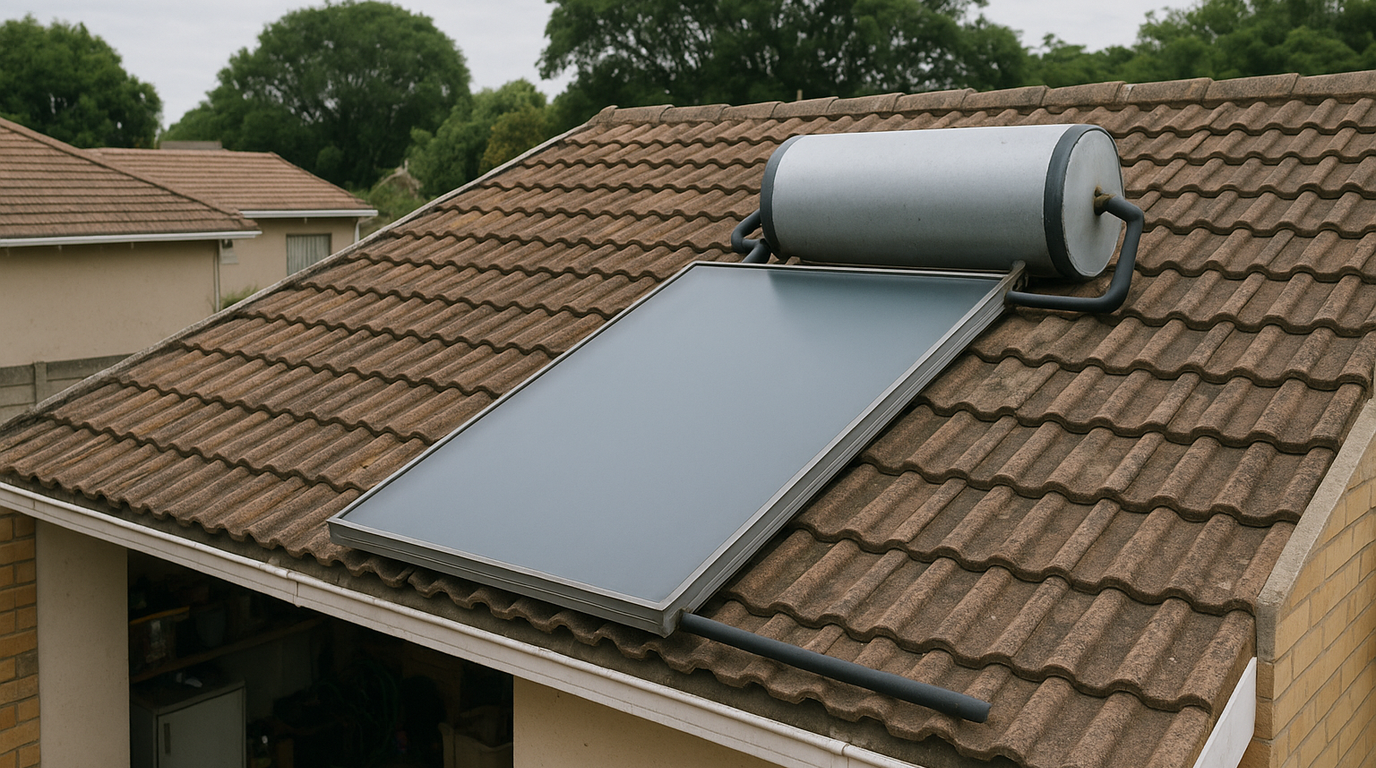
A flat plate collector is the simplest, most common way to heat a home’s water from sunlight, and it has been used on South African roofs for decades. It is the box-shaped panel most people picture when they think of a solar geyser on the roof.
What a flat plate collector is and how it heats water
A flat plate collector is a shallow, rectangular box that sits on your roof and uses sunlight to warm a fluid. The hot fluid then heats water in a tank, which feeds your taps and shower the same way a normal electric geyser does.
Sunlight passes through a glass or tough-plastic cover and lands on a flat metal plate painted dark. That plate warms up, and the heat transfers to water or a glycol mix flowing through pipes behind it. The warm fluid rises into a storage cylinder, where the heat transfers to your household water.
The collector does not make electricity. It only heats water. For the rest of the house — lights, fridges, kettles — you would still need a separate solar PV system.
The parts inside a flat plate collector
From the sun-facing side inwards, a flat plate collector is built up of a transparent cover, a dark absorber plate, a grid of small pipes or tubes that carry the fluid, an insulated back panel, and a metal frame that holds it all together. The dark coating does most of the actual heating work. The cover lets sunlight in but traps some of the heat from escaping back out.
Flat plate collector vs evacuated tube: which is better where you live
Both do the same job. They just handle heat loss differently. Evacuated tubes are a row of sealed glass cylinders, and each one is a small vacuum flask. Flat plate collectors are one wide flat box with a single glazed cover.
Flat plate collectors are simpler, cheaper to make, and easier to mount on a tiled or flat roof. They work very well in warmer parts of the country and in mild winters. Evacuated tubes hold heat better in cold, windy, or frosty conditions, which is why you see more of them on the Highveld.
The honest downsides of flat plate collectors are worth knowing. They lose more heat overnight, so winter output dips more than tube output does. The cover can mist over after years of sun and slowly lose transparency. The whole panel is also heavier per square metre than a row of tubes, which matters on some roof types.
How a flat plate collector is plumbed into a South African home
The collector feeds a storage tank, and the tank feeds your hot water pipes. The collector sits on the roof. The tank can sit on the roof next to it, or it can sit on the ground in the roof space or against a wall, depending on the system type.
A cold water inlet feeds the tank, and a hot water outlet feeds your existing geyser circuit. An electric element, or sometimes a gas burner, sits inside the tank as a backup for cloudy days. Your existing mixers, pipes and pressure control stay the same.
Thermosiphon vs split pumped systems
In a thermosiphon system the tank sits higher than the collector, usually on the roof right next to it. Hot water rises on its own into the tank, so there is no pump and no controller. It is simple, quiet and cheap to run. The trade-off is weight on the roof and a slightly smaller tank in practice.
In a split pumped system the tank sits lower down, often at floor level, and a small pump pushes the fluid around. The collector can be on the roof and the tank can be anywhere. This is the right choice when the roof cannot carry a full tank of water, or when you want a larger cylinder.
Roof rules: angle, direction, and shade in South Africa
You want the collector to face north and tilt at roughly the same angle as your latitude. Most of South Africa sits between 22 and 34 degrees south, so a roof tilt in the high 20s to low 30s works well for year-round hot water. A north-facing pitched roof with no shade gives the best yield.
An east- or west-facing roof still produces useful hot water, just earlier or later in the day. Heavy shade from a tree or a neighbouring building cuts output sharply. A north roof with one shaded panel will out-perform an east roof that gets full afternoon sun.
On a flat roof you mount the collector on a tilt frame. On a pitched roof you mount it on rails fixed to the rafters. Both jobs are standard for an experienced installer.
How big a system your household actually needs
The rough rule is around 50 litres of hot water storage per person per day for a normal household. A family of four typically lands on a 200 to 300 litre tank paired with a 2 to 4 square metre flat plate collector.
Usage patterns matter as much as the head count. A house with teenagers who shower twice a day uses more hot water than a quiet couple. A home with a dishwasher running most evenings uses more than one without.
Sizing the tank for a family of four or more
For four people, plan on a 300 litre tank and around 3 square metres of collector area as a sensible starting point. If you have a bath rather than just a shower, or if you run a washing machine on hot, push the tank up. If you mostly shower, the lower end of the range works.
What a flat plate collector costs and what drives the price
Final price depends on collector size, tank size, mounting frame, plumbing rework, and whether you retrofit to an existing electric geyser or fit a full replacement system. Roof height, roof material, and how far the tank sits from the collector all move the number too.
A retrofit, where the collector pre-heats water into your existing geyser, is the cheaper route. A full replacement, with a new tank and a pumped split system, costs more but gives you a larger, better insulated cylinder and more hot water in a day.
For sizing and tariff context, Eskom reports that NERSA has approved an average electricity price increase of 8.76% for customers supplied directly by Eskom, with municipal bulk purchasers implementing tariff increases averaging 9.01% from 1 July 2026 (Eskom). Over a longer window, the CSIR notes that the national average electricity tariff increased by an average of 10% per year from 2014 to 2024, compared with average inflation of 5.2% over the same period (CSIR). Heating water is one of the bigger line items on that bill, which is why a collector recovers its cost within a few years in many homes. The 25% SARS solar tax rebate on new, unused PV panels, capped at R15 000, sits on the PV side of the bill, not the solar water heater itself, so it does not offset a collector install on its own (SARS).
Maintenance, lifespan, and when to replace
Annual maintenance is light. Wipe the cover so sunlight gets through. Have the pressure relief valve and check valve checked once a year. Look at the pipe insulation on the roof for UV damage. That is about it.
A well-installed system lasts 15 to 25 years. The collector itself usually outlasts the first backup element, which is a cheap part to swap. The glazing is the part most likely to need attention, and a misted cover slowly drags down output until you replace it.
Flat plate collectors and power interruptions: what to expect
A properly sized system with a thermosiphon design keeps heating water during outages, because the fluid still circulates on its own. The hot water you stored before the outage stays hot in an insulated tank for a day or more.
A pumped split system needs the pump to run. If your pump is wired to the grid, it stops during outages and you fall back on whatever hot water is already in the tank. If outages are a daily part of life at your house, a thermosiphon design, or a backup on the pump circuit, is worth thinking about.
For context, Eskom reports that the Energy Availability Factor has risen to 65.85% year-to-date (1 April 2025 to 12 March 2026), with the fleet reaching or exceeding 70% on 83 occasions so far (Eskom). The baseload units that anchor the system have moved from 9% availability two years ago to above 98% today. Outages still happen, which is why a hot water setup that does not lean on the grid keeps its value.
Choosing an installer: a short homeowner checklist
Before you sign, ask the installer a few straight questions. Is the collector and tank SABS marked. Will they issue a Certificate of Compliance from a registered electrician for the backup element. Who does the plumbing, and is that person a registered plumber. What is the warranty path if a panel fails, and who handles the claim. Will they size the system to your actual usage, or quote you a one-size package.
A good installer answers all of these without hesitating. A poor one waves the questions away. The size of the quote tells you less than the quality of the answers.
If you want to spread the upfront cost, ask about finance. ZenSolar offers rent-to-own, power purchase agreements, and wheeling agreements, and these options are available for both residential and commercial customers. Spread payments over a few years and the monthly cost often lands below the saving on the electric bill.
Common questions about flat plate collectors
Can a flat plate collector work in cloudy weather? Yes, output drops, but a glazed collector still picks up usable heat from diffuse light on overcast days.
Does the system need a pump? Only on a split pumped design. A thermosiphon system moves fluid by itself.
Will it freeze on the Highveld in winter? A properly plumbed system with a glycol mix or a drain-back design handles frost. Ask the installer which approach they use.
FAQ
Are flat plate collectors any good in winter on the Highveld? They work, but yield drops more than evacuated tubes do. If you live in a frost pocket, ask for a glycol-filled system.
Can a flat plate collector work during power outages? A thermosiphon system keeps heating, and a pumped system keeps delivering already-hot water from the tank for as long as it stays warm.
How long does a flat plate collector last? A well-installed system typically runs 15 to 25 years, with the backup element swapped once or twice in that time.
Will a flat plate collector heat a swimming pool? Not the right tool. Pool heating needs a different, cheaper collector type that handles lower temperatures.
Do I need a Certificate of Compliance for a solar geyser install? Yes. Any new electrical work on the backup element must be signed off by a registered electrician who issues a COC.
Book a site visit and we will measure your roof, your usage, and your hot water habits before you spend a cent: schedule a ZenSolar assessment.