Most guides hand you a panel count with no maths behind it, so the number feels arbitrary. The real answer depends on your geyser size, your element rating, and whether you heat by day or through a battery, and it is short enough to do on a piece of paper.
What an electric geyser actually uses each day
An electric geyser heats water with a resistance element, then stores it in an insulated tank. The energy it uses depends on the tank size, the cold inlet temperature, and how hot you set the thermostat.
A typical South African geyser runs at around 150 L or 200 L. GeyserTECH Solar puts average geyser use at roughly 5 kWh a day, with a large family pushing closer to 10 kWh.
Hot water use is steady through the year. Showers and washing do not stop in winter, so the geyser remains one of the bigger single loads in a home.
The basic maths, from litres to kWh
Heating water takes a fixed amount of energy. The formula is simple: energy (kWh) equals litres times temperature rise times 0.001163.
A 150 L tank heated from 15 °C to 60 °C is a 45 °C rise. That is 150 times 45 times 0.001163, which is about 7.85 kWh per full reheat. A 200 L tank on the same rise needs about 10.5 kWh.
Most households do not reheat from cold every day. They heat back what they use, often half a tank or less. That is why real-world use sits closer to the 5 kWh figure GeyserTECH Solar reports.
How many panels for a 150 L geyser
A standard 150 L geyser with a 2 kW or 3 kW element uses roughly 5 to 8 kWh a day in a typical home. To cover that with panels only during sun hours, you need enough wattage to deliver the energy in about four peak hours.
Three 500 W panels give you 1.5 kW of PV. That produces around 5.27 kWh in four hours of sun, which matches the average 150 L home, as shown in this GeyserTECH Solar example. Four panels gives you headroom for cloudy days and a larger family.
So the short answer for a 150 L geyser is three to four 500 W panels for direct daytime heating, more if you want to cover a full reheat from cold.
How many panels for a 200 L geyser
A 200 L geyser needs more energy per cycle, around 10 to 11 kWh from cold. Daily use is often 7 to 10 kWh in a busy house.
Five 500 W panels give you 2.5 kW of PV and roughly 9 kWh in four sun hours. That covers most 200 L homes. Six panels adds the buffer a large family or a colder region needs.
Plan on five to six 500 W panels for a 200 L tank on direct PV heating.
Daytime heating straight from the panels
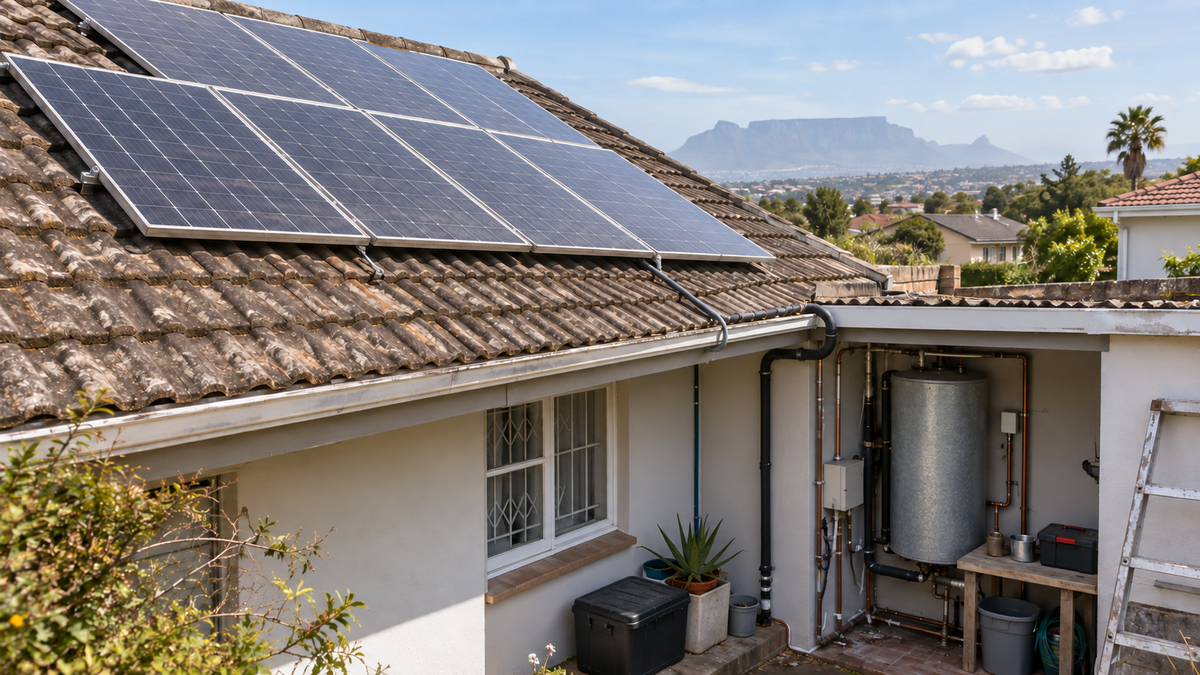
Direct PV means a DC element or a PV controller feeds the geyser element when the sun is up. The GeyserTECH Pi2R iX can run a 4 kW element on up to 300 L tanks this way.
The trade-off is timing. You only heat when the sun is strong, so morning and evening showers draw from the tank the sun refilled earlier in the day.
Heating through your inverter and battery
If you already have an inverter and battery, the geyser element runs as an AC load. You can heat any time, day or night, using stored energy or grid top-up.
The trade-off is round-trip loss and battery wear. Heating 8 kWh of water through a battery costs more in panel output than heating it straight from the sun at midday.
Element size changes the answer
A 2 kW element takes longer to reheat a tank than a 3 kW or 4 kW element. If you have a 2 kW element, you need more sun hours or a bigger PV array to push the same energy.
The same 1.5 kW of panels that delivers 5.27 kWh with a 3 kW element only delivers 3.94 kWh when paired with a 2 kW element, because the element caps the power, as this GeyserTECH Solar example shows.
Standard AC elements run on alternating current. DC elements are designed for direct PV use and avoid inverter losses, but they change the wiring and the controller you need.
Does it work in winter too
Winter is the honest test. The water entering the tank is colder, so the temperature rise is bigger and the kWh per litre goes up. Sun hours also drop and clouds are more common.
On a north-facing roof with no shade, most South African sites still get three to five peak sun hours through winter, depending on region. Eskom reports an Energy Availability Factor of 65.85% year-to-date to 12 March 2026, which shows the grid is steadier, but solar output in winter still trails summer.
Add one or two panels of margin if you live in a cold part of the country, or face east or west instead of north.
When running the geyser on PV is the wrong move
Sometimes the right answer is to skip PV-for-geyser entirely. If your roof is small, shaded, or already full of panels for the rest of the house, adding more panels just for hot water is poor economics.
If the geyser is old, replacing the element and thermostat with a more efficient setup often pays back faster than adding panels. And if the tank is poorly insulated, you lose heat overnight and waste the energy you generated.
A heat pump instead
A heat pump uses about a third of the electricity of a resistance element for the same hot water. It works day and night, off grid or solar, and fits most existing tanks with a retrofit kit.
It is often the lowest-cost way to cut geyser running costs in South Africa today, especially when panels would otherwise cost more than the saving.
A proper solar water heating system instead
A flat-plate or evacuated-tube solar water heater heats water directly, with no element and no inverter. It has worked in South Africa for decades and pairs well with a small electrical backup element.
For homes that use a lot of hot water, this is often the cleanest fit, and it frees your PV array for other loads.
What to confirm before you buy
Ask the installer to size the array against your actual hot water use, not a generic rule of thumb. Bring your last three months of electricity bills and the geyser tank size.
Ask whether the element is AC or DC, and which controller they recommend. DC elements need a matched PV controller, while AC elements need inverter and battery headroom.
Ask about panel orientation. CSIR data shows the South African resource is strong when roofs face north with no shading.
Finally, ask for the total installed price in rand, written, with the panel brand, the element rating, and the controller model on the quote. If the installer will not put that in writing, find one who will.
FAQ
Can a 10 kW solar system run a geyser? Yes, a 10 kW PV array can run a geyser element on a sunny day and still cover most of a home’s other loads. The geyser only needs 2 kW to 4 kW of that at any moment.
How many solar panels do I need for a 150 L geyser? Three to four 500 W panels cover average daytime use, with a fifth panel useful as a winter buffer in colder regions.
How many solar panels do I need for a 200 L geyser? Five to six 500 W panels cover most homes, with more needed for full cold-start reheats or large families.
Can you run a geyser directly off solar panels? Yes, with a DC element and a PV controller such as the GeyserTECH Pi2R range, or through an inverter with battery backup for AC elements.
How do I connect solar panels to my existing geyser? Match the panel string voltage to the controller or inverter, decide series or parallel wiring for your roof layout, and have a licensed electrician do the final AC connection.
Ready to size a system for your roof and your geyser? Book a site visit and we will work the maths on your house, not a generic example.