
Solar water heaters get sold with numbers that rarely match what arrives on the roof. Here is what an evacuated tube actually is, how it heats water, and who it suits in South Africa.
An evacuated tube is a glass tube with a vacuum gap between an outer shell and an inner glass tube. A dark coating on the inner tube absorbs sunlight. The vacuum holds the heat in, so most of it reaches the water instead of leaking into cold air.
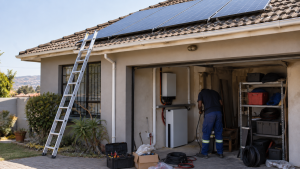
Tubes are usually grouped in a row on a roof frame, tied to a tank that holds the hot water. Some tanks sit on the ground. Either way, the job is the same — turn sun into hot water for the bath, basin and kitchen.
How it heats water, step by step
Sun hits the dark coating on the inner tube. The coating warms up and passes heat to a metal fin or to water flowing through the tube. Warmer water rises into the tank, cooler water moves down to take its place. By the end of a sunny day the tank is hot, and an insulated tank keeps that heat into the next morning.
Why the vacuum matters
Heat moves three ways — conduction, convection and radiation. A vacuum strips out conduction and convection, which are the two big losses on a cold Highveld morning. The tube can stay hot even when the air around it is near zero, which is why tubes handle cold snaps better than older flat panels.
Direct vs indirect (glycol) systems
A direct system sends drinking water straight through the tubes. It is simple and efficient where frost is rare. An indirect system uses a glycol fluid in the tubes and a heat exchanger in the tank. The glycol keeps the tubes from freezing, which matters in frost pockets and on the Highveld in winter.
Evacuated tube vs flat plate, honestly
Both work. Each has a job it does better than the other. The right choice is about your roof, your climate and how much hot water you actually use.
Where tubes win
Tubes hold their heat on cold, cloudy mornings. Individual tubes can be swapped out if one breaks, so repairs cost less than a full panel replacement. They also weigh less per tube than a flat panel of similar output, which helps on older roofs.
Where flat plates hold their ground
Flat plates are a tougher single unit and stand up to hail and rough handling better than tubes. On a coastal roof with strong midday sun and no frost, the difference in performance narrows. If your roof gets heavy ladder traffic for other work, a flat plate is the more forgiving option.
Why South African homes often end up with tubes
South Africa has three very different roof climates. The right collector depends on which one you live under.
Highveld winters and cloudy days
Johannesburg, Pretoria and Bloemfontein get cold, dry winters with frost and frequent high cloud. The CSIR reported that Eskom’s average Energy Availability Factor rose to 60% in 2024 as unplanned failures dropped, but outages still shape how households plan hot water around off-peak hours. Tubes pull heat out of weak winter sun better than older flat panels, which is why they dominate new installs in this band.
Coastal humidity and bushveld heat
On the KwaZulu-Natal and Western Cape coast, salt air ages metal fittings faster, and humidity lowers the useful heat gain from a flat panel. Tubes have less metal exposed. In the bushveld, summer heat can push a closed system past 100 degrees and trigger pressure relief often. A tank with a proper expansion tank and a tempering valve handles this, and tubes alone do not solve it.
Sizing for a typical household
A rough rule is one tube per person in the home, then add one for the kitchen and one for cloudy days. A four-person home usually lands on 20 to 30 tubes and a 200 to 300 litre tank. Heavy-use homes with teenagers, a dishwasher and a washing machine that runs on hot should size up, not down.
The tank should match the tube count. Undersize the tank and the water cools fast overnight. Oversize the tank and the sun cannot heat it back up by sunset. Most retrofits into an existing 200 litre electric geyser need 20 tubes at minimum to make a real dent in the bill.
New system or retrofit onto an existing geyser
A retrofit keeps the existing electric geyser and bolts tubes onto the roof with a small pump and a controller. It is cheaper and faster, and it suits a home where the current geyser is in good nick and the electrical Certificate of Compliance is still current.
A full new system makes more sense when the existing geyser is old, leaking or undersized, when the roof needs structural work, or when the homeowner wants an indirect glycol loop for a frost-prone area. The decision is about the geyser, not the tubes.
Maintenance and the lifespan of the tubes
2.
Plan a check once a year and a visual look-over after big hail. The annual check is a flush of the glycol loop on an indirect system, a valve and pressure relief test, and a quick look at the anode in the tank. A tube that loses its vacuum shows as a white haze inside the glass — it is no longer insulating and should be swapped.
Tubes typically last 10 to 15 years before vacuum loss becomes common. The tank and frame usually outlive the tubes. Replacing a single tube costs far less than replacing a full flat panel, which is one reason tubes suit budget-conscious homeowners who plan to stay put.
How tubes work with backup heating and with solar PV
No solar water heater heats water every day of the year. A backup element or a heat pump handles the overcast stretch. On solar PV homes, the element can be wired to run off-peak so the geyser fills on cheap rate, freeing daytime PV for the rest of the home.
During load reduction the hot water cylinder becomes useful storage. A full 200 litre tank holds a day or two of hot water if the household drops to short showers and turns the element off. That buffer is one of the quiet wins of a solar geyser on a PV-plus-battery home.
What a good quote should include, line by line
- The tube count, the tank size and whether the system is direct or indirect.
- Roof mounting frame, with a note on whether the existing roof structure can carry the load.
- A new tempering valve and an expansion tank on closed systems.
- Plumbing rework, lagging on the pipe run, and a drip tray where required.
- A controller, a circulation pump and the electrical work, plus a Certificate of Compliance from a registered electrician.
- Disposal of the old geyser if a full replacement is on the quote.
- Warranty terms for the tube collector, the tank and the backup element, written separately.
If any of these sit as ‘extras’ in the small print, the headline number is misleading. An installer who walks the roof and shows you each item is worth more than the cheapest line on the page.
Cost in Rand and what drives it
An installed retrofit system for a four-person home in South Africa typically lands in the low five figures, depending on tube count, tank size, roof access and region. A full new system with a 300 litre tank and an indirect glycol loop costs more, and coastal or remote sites push the figure up.
The drivers are simple — tube count, tank material, indirect or direct, roof height and access, the electrical work, and how far the pipe run is from the existing geyser. The 25% SARS solar tax rebate on new and unused PV panels, capped at R15 000, sits on the PV side of the bill, not the solar water heater itself, so it does not offset a tube install — a point worth raising with a tax practitioner if the quote mixes PV and water heating.
On tariff pressure, Eskom’s NERSA-approved average price increase of 8.76% for direct customers from financial year 2027, with municipal bulk purchasers averaging 9.01% from 1 July 2026, keeps pushing the grid rate up. That is the number any payback estimate has to be honest about.
The estimated payback on a retrofit system varies by tariff, consumption, system size and how the household uses hot water. A home that runs two showers and a dishwasher on hot every day will see the figure fall faster than a quiet home with one short shower. Get the number for your own roof, your own tariff and your own usage before you plan around it.
National rooftop capacity tells the wider story. GreenCape reports rooftop solar PV reached 3.2 GW of installed capacity in 2023, with a residential, commercial and industrial addressable market of about 10 GW by 2030. That scale is why parts and accredited installers are easier to find now than five years ago.
FAQ
How many tubes do I need for a four-person household?
Most four-person homes land on 20 to 30 tubes with a 200 to 300 litre tank. Heavy users should size up.
Do evacuated tubes work on overcast Highveld days?
They still pull useful heat from diffuse light and outperform older flat panels in cloud, though output drops well below a summer sunny day.
Can I retrofit tubes onto my existing electric geyser?
Yes, if the geyser is in good condition and the electrical Certificate of Compliance is current. Otherwise a full replacement is the cleaner choice.
How long do evacuated tubes last before they need replacing?
Individual tubes usually last 10 to 15 years, and a single failed tube can be swapped without touching the rest of the array.
Will a solar geyser cut my bill enough to matter?
For a four-person home on a standard tariff, the estimated payback varies by usage and tariff structure. Run the numbers with your own consumption before you commit.
Book a site visit and ZenSolar will check your roof pitch, shading, existing pipework and electrical backup before any number is put on paper. Schedule the visit here.