Once you have settled on a hybrid inverter, the battery question follows immediately. If your inverter is a Sunsynk, you will meet a specific dilemma: pair it with Sunsynk’s own battery range, or with a specialist storage brand like Freedom Won? Both have a real installed base in South Africa and both do the fundamental job well. We should say plainly where we stand before you read any further: ZenSolar fits neither of them. We install Fox ESS and Sigenergy, and we set out why further down. That is a reason to read this with your eyes open, not a reason to distrust it — the specifications below are the same specifications whoever quotes you. Brands like Pylontech and Hubble compete mostly on price; Sunsynk and Freedom Won sit a level up, and the choice between them comes down to philosophy more than function. This guide walks through where the two are the same, where they differ, and which kind of buyer each one suits.
Two brands, two philosophies
Freedom Won: the storage specialist
Freedom Won is a South African company whose business is energy storage. It designs and builds lithium battery systems locally for homes, businesses and industrial sites, and it has built its reputation on exactly one thing: batteries. Its products are engineered to be brand-agnostic, designed to communicate with the major hybrid inverter platforms sold in South Africa, including Sunsynk, Deye and Fox ESS.
Sunsynk: the ecosystem play
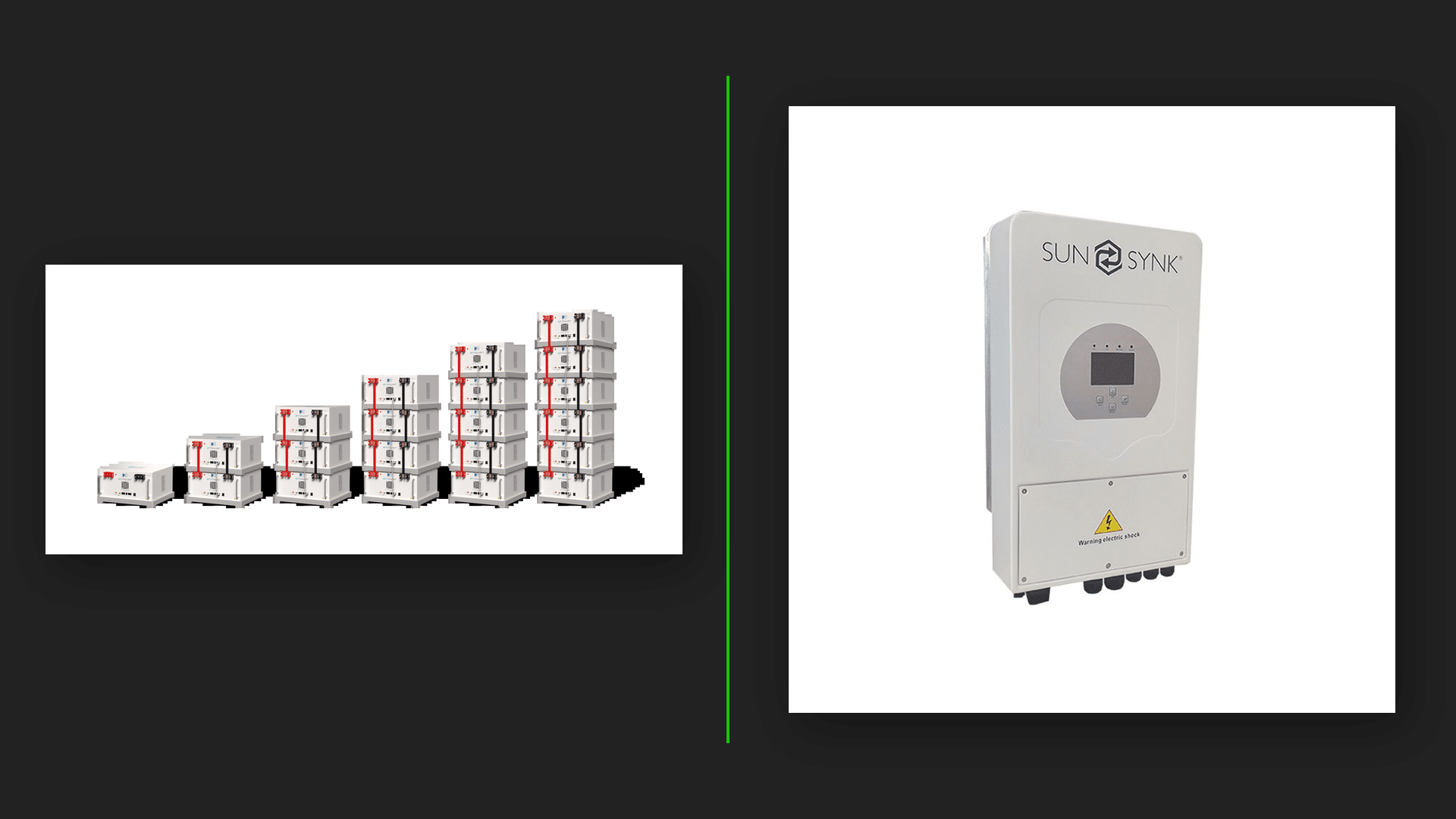
Sunsynk is best known for its hybrid inverters, and its battery range exists to complete that picture: storage designed, branded and supported by the same company as the inverter, built to fit directly into a single-vendor system. The appeal is coherence. Your inverter and battery come from one company, with one app and one number to call if something goes wrong.
Where they are equals
Start with what does not separate them, because it is most of the technical picture:
- Chemistry. Both build on lithium iron phosphate (LiFePO4), the stationary-storage standard chosen industry-wide for thermal stability, long cycle life and high usable depth of discharge. Neither brand holds an advantage here.
- Battery management. Both integrate management systems that supervise cells and communicate with the inverter in a closed loop.
- Sunsynk compatibility. On a Sunsynk inverter specifically, both are legitimate, supported pairings. This comparison has no wrong answer at the compatibility level. Confirming the exact model pairing at design stage is standard practice either way.
- Local market credibility. Both are established in South Africa with real installed bases. For the chemistry fundamentals behind all of this, see solar batteries: what is the difference?
Where they genuinely differ
1. Local manufacture vs global ecosystem
Freedom Won’s storage is engineered and built in South Africa, with support, documentation and warranty processing rooted in this market. Sunsynk’s batteries come out of the same international product organisation as its inverters, with support running through Sunsynk’s distribution network. If locally built and locally supported matters to you, whether for support proximity or for backing South African manufacturing, Freedom Won owns that ground. If a single global brand across your whole system appeals more, that is Sunsynk’s home turf.
2. Inverter freedom, now and later
A subtle but real difference: Freedom Won’s brand-agnostic design keeps your storage independent of your inverter choice. If you ever replace or upgrade your inverter, or add a system at another property on a different platform, a specialist battery carries across ecosystems in a way a single-vendor pairing may not. Buyers who value long-term optionality tend to weight this heavily; buyers who intend to stay inside one ecosystem reasonably do not.
3. Integration and monitoring experience
In an all-Sunsynk system, battery and inverter sit in one monitoring app, with a single vendor responsible for how well they work together: one phone call if something goes wrong, and nobody to point to but Sunsynk. A Freedom Won pairing is also fully monitored through your inverter platform, and closed-loop communication between the two is standard. The practical difference is that two manufacturers stand behind two components instead of one. With official-channel stock and a competent installer, both approaches work. They just spread responsibility differently.
4. Range shape
Freedom Won’s range runs from compact residential units to large commercial systems, built around a storage specialist’s catalogue. Sunsynk’s battery range is shaped around its own inverter line-up and the typical residential systems built on it. For unusual capacity needs or commercial-scale banks, the specialist catalogue tends to give you more room to move. For a mainstream home system, both ranges cover the ground comfortably.
Head-to-head: popular models compared
Talk to enough installers and two model names keep coming up: Freedom Won’s eTower range on the specialist side, and Sunsynk’s own battery line, including the L5.1, on the ecosystem side. Both are common pairings for a Sunsynk inverter, and both come in larger, commercial-scale versions too.
We are not going to publish a capacity-by-capacity spec table here. Usable capacity, cycle life, depth of discharge and warranty terms change as manufacturers update model lines, and quoting a figure that goes stale within a year does you no favours. What we can tell you is how the two ranges are built to be used.
- Build type. Freedom Won’s eTower units are stackable modules designed to add capacity in steps. Sunsynk’s range is built the same way, sized to sit alongside its own inverters.
- Typical use case. Freedom Won covers everything from a single home battery to a large commercial bank from one catalogue. Sunsynk’s range is scoped mainly around the residential and small commercial systems its inverters serve.
- Expansion approach. Both let you add modules later instead of replacing the whole bank, so your first purchase does not have to be your last.
- Warranty and support process. Each brand runs its own warranty through its own channel, with terms set per model rather than per brand. Buy through an official channel and register the product, and either warranty is enforceable. Skip that step, and neither is.
For the current capacity, pricing and warranty length on a specific model, check the product pages on our System Sizer or ask for a quote. Those figures move with the market more often than an article like this one gets updated.
Where Fox ESS and Sigenergy fit into this
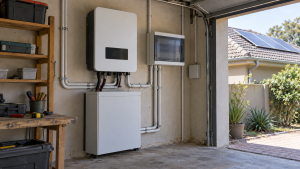
We fit two battery and inverter brands and no others: Fox ESS and Sigenergy. That is a deliberate narrowing, and it is worth explaining rather than asserting.
One platform from a small house to a commercial site. The most expensive mistake in home storage is outgrowing your ecosystem. A household that adds a heat pump, a pool, an EV charger or a home office two years after commissioning frequently discovers that scaling means changing brand, and changing brand means changing inverter, app and support channel at the same time. Both Fox ESS and Sigenergy run continuous product families from single-phase residential through to three-phase commercial and industrial, so growth is a capacity decision rather than a replacement decision.
Sigenergy’s architecture is integrated rather than assembled. The SigenStor stack combines PV inversion, battery storage, system control and DC EV charging in one modular unit instead of four separately sourced boxes with four warranty conversations behind them. When something needs attention, there is one manufacturer to attend to it. That is a support argument as much as a technical one, and support is where most storage complaints actually originate.
Sigenergy’s warranty is written down, and we will show it to you. Sigenergy’s published warranty documents carry a 10-year term on the Sigen Battery and the Sigen Energy Controller, with the battery guaranteed to retain at least 60% of its usable capacity at 10 years, or a stated energy-throughput limit, whichever is reached first — extendable to 15 years if the system is purchased and registered within 12 months of commissioning. We quote those numbers because we can point at the document they come from. Ask any installer quoting you a battery to do the same; the answer tells you a great deal.
Fox ESS is the volume-sensible half of the pair. Fox ESS sits behind Tsingshan Group and builds modular, stackable storage designed to be added to rather than replaced, across single-phase and three-phase inverters. Where Sigenergy is the integrated premium answer, Fox ESS is the one that gets a well-specified system onto a normal budget without dropping into the price tier where support disappears.
What we are not going to pretend. Freedom Won is manufactured in South Africa, and that is a real advantage for lead times, spares and local accountability that no imported brand can simply claim away. Sunsynk’s single-vendor coherence is real too — one brand, one app, one number to call has genuine value. Neither of those is a bad choice, and we are not going to tell you they are. What we will tell you is what we are prepared to stand behind for the next decade, in writing, and that list has two names on it.
So which should you choose?
- Freedom Won makes sense if local manufacture and locally held spares are the deciding factor for you, or your capacity requirement sits outside the mainstream residential band.
- Sunsynk makes sense if you already have a Sunsynk inverter and single-vendor coherence outweighs everything else.
- Fox ESS or Sigenergy is the better buy if you want the warranty terms in writing before you sign, you expect the system to grow, or you would rather have one manufacturer accountable for the whole stack than four suppliers pointing at each other. That is the case we make, and it is the reason we narrowed to two brands rather than carrying whatever was in stock.
What you should not do is let the brand question crowd out the capacity question. An ideally branded battery at the wrong size fails you every evening; a correctly sized battery serves you for years. Size first (our guide on how to size a solar system shows how), then settle the brand.
The economics are the same argument for both
Whichever badge is on the cabinet, the battery’s job is identical: store your midday solar surplus and displace the evening electricity you currently buy at Eskom tariffs that climb above inflation every year. With storage hardware cheaper than it was a few years ago, that arithmetic is the strongest it has been in a decade, whichever brand you choose. Test it against your own consumption with our free solar ROI assessment, read is a solar system worth it? for the framework, and if you plan to finance rather than pay cash, our guide to solar power financing options maps the routes.
Get a design, not just a verdict
ZenSolar fits Fox ESS and Sigenergy, so our recommendation is a design, not a shelf-clearing exercise. Model your consumption in the free System Sizer, then request a personalised quote. We will size the storage to your evening usage, pair it correctly with your inverter, and install the result through a manufacturer-approved installer — which is what keeps the warranty on the hardware valid.
Frequently asked questions
Will a Freedom Won battery work as well on a Sunsynk inverter as Sunsynk’s own battery?
Yes. Freedom Won batteries are designed for closed-loop communication with the Sunsynk platform, and the pairing is common in South African installations. Commissioning matters more than branding here: whichever battery you choose, the installer must enable and verify the communication link so the inverter manages the battery on real data. Insist on it from whoever does your installation. ZenSolar fits neither of these brands — our systems are Fox ESS and Sigenergy — but the commissioning rule is the same either way.
Do I need to change any Sunsynk inverter settings to use a Freedom Won battery?
Yes, in general. Whatever battery you pair with a Sunsynk inverter, the installer needs to select the correct battery type and communication protocol in the inverter’s settings so it reads the battery’s actual state of charge instead of guessing from voltage alone. Any competent installer should handle this as part of commissioning. ZenSolar does not install Sunsynk or Freedom Won; we fit Fox ESS and Sigenergy.
Is one brand’s warranty better than the other’s?
Both brands stand behind their products through their respective support channels, and warranty terms are defined per model, so compare the current written terms for the exact units quoted rather than relying on brand reputation. The practical rule is the same for both: official-channel stock, bought through an established retailer, is what makes any warranty enforceable in South Africa.
Can I mix the two brands in one system?
Not within one battery bank. A bank must be built from matching modules under one management system. Across separate systems, or a future second installation, nothing ties you to your first choice, which is one reason some buyers value the inverter-independence of a specialist battery brand.
How do Freedom Won and Sunsynk compare with other brands like Pylontech or Hubble?
Pylontech and Hubble compete mainly on entry price. ZenSolar fits none of these four — we install Fox ESS and Sigenergy — but the distinction is still worth understanding: Freedom Won and Sunsynk sit a level above the price tier, one as a dedicated storage specialist, the other pairing its battery with its own inverter for a single-vendor system. If budget is your main driver, compare them against your sizing requirement rather than on brand name alone.
Which one does ZenSolar recommend?
Neither, if you are asking what ZenSolar would fit. We install Fox ESS and Sigenergy, for the reasons set out above. If you are asking which of the two is the better battery in the abstract, that genuinely depends on your capacity requirement, expansion plans and inverter pairing rather than on a house favourite — and the comparison above is written to help you answer it either way.
Not sure which system is right for you?