Key Takeaways
The following guide provides a technical overview of how to integrate energy storage into a self-sufficient power installation using high-quality components. Managing your own power supply requires attention to capacity, environment, and system compatibility.
- Lithium Iron Phosphate chemistry provides the foundation for stable, long-term energy storage systems.
- Residential users should carefully match specific product ranges like the eTower to their daily consumption patterns.
- Usable energy metrics and peak power output dictate the true effectiveness of your storage array under heavy load.
- Proper site selection and ventilation play a significant role in protecting internal battery components from environmental stress.
- Effective communication between the battery management system and your hybrid inverter is essential for accurate state-of-charge reporting.
Understanding the core technology of Freedom Won batteries
The advantages of LiFePO4 chemistry
Lithium Iron Phosphate (LiFePO4) chemistry is the industry standard for modern, reliable energy storage. This chemical composition offers an exceptionally stable electrochemical structure that resists overheating and thermal runaway, which makes it far safer than older lithium-ion variants. By choosing this chemistry, you ensure that your energy system operates with a high cycle life while maintaining consistent performance across varying ambient temperatures.
Understanding depth of discharge and cycle life
The longevity of your battery system depends heavily on how you manage its depth of discharge. Unlike lead-acid alternatives that suffer performance degradation under deep cycles, LiFePO4 chemistry allows you to withdraw a significant percentage of stored energy without compromising the internal integrity of the cells. Consistent monitoring prevents you from overdrawing the unit beyond its designed limits, which protects your investment over the long term.
Thermal management and safety profiles
Safety is engineered into the design of these batteries through built-in thermal management systems. Each module is designed to operate within strict temperature parameters, automatically adjusting its behaviour if external conditions become too volatile. This safety profile ensures that your system functions correctly even during intense heat or high-demand scenarios that might otherwise trigger a fault state.
Navigating the diverse Freedom Won product ranges
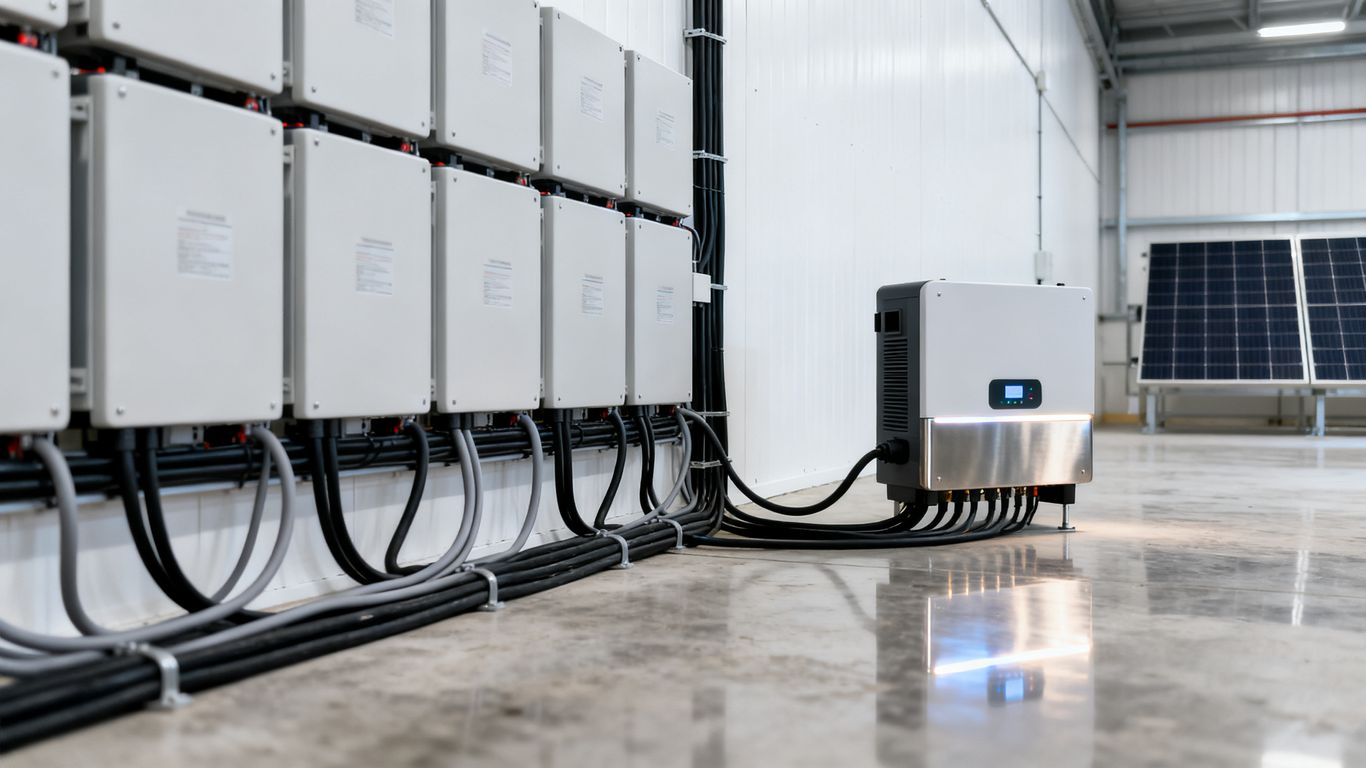
Comparing the eTower series for residential use
You might consider the Freedom Won eTower Battery 5kWh E5000 for your home if you require a compact solution that integrates easily with common residential hybrid inverters. This range provides excellent value for those looking to manage daily self-consumption without needing massive floor space. It delivers consistent output for regular household appliances, balancing efficiency with a smaller physical footprint.
Suitability of eFreedom models for commercial applications
Businesses require different performance thresholds to ensure continuity and protect margins during high-demand daytime operations. The eFreedom lineup accommodates larger scale requirements where consistent power delivery is necessary to run heavy machinery or office infrastructure. These units are built to withstand the rigorous duty cycles typical of commercial settings, allowing for a scalable architecture that adapts as your business growth dictates.
Scalability options for varying energy demands
Modular design permits you to expand your total storage capacity by adding units in parallel as your requirements grow. Whether you start with a single tower or build out an array for a larger facility, the system allows for seamless integration. You can assess your specific needs by using our ROI solar calculator to determine how much capacity serves your current business or domestic power consumption best.
Analysing key performance specifications
Nominal capacity and usable energy metrics
Nominal capacity gives you the headline figure for what the battery holds, but usable energy tells the actual story of what you have available for daily use. You must account for the efficiency losses during the conversion process within your inverter interface to understand exactly how much work your battery can complete. It is the usable portion that defines your true energy independence.
Peak power output and surge capabilities
Surge capacity is the ability of your system to handle high-draw events, such as when a large appliance or induction motor starts. Understanding this metric allows you to build a system that manages these intermittent loads without tripping your protections. The following table illustrates typical performance tiers for varying storage modules:
| Module Type | Nominal Power Output | Max Surge Capacity |
|---|---|---|
| Compact Series | 5 kW | 8 kW |
| Standard Range | 10 kW | 15 kW |
| Industrial Unit | 20 kW | 30 kW |
Selecting a unit with sufficient headroom ensures your appliances operate smoothly regardless of simultaneous high-power demand.
Voltage compatibility with common hybrid inverters
To keep efficiency high, your battery voltage must align perfectly with your hybrid inverter’s input range. When these components communicate at the correct DC voltage, the system operates with lower thermal losses across the cabling. You should learn more about our services to verify that your chosen inverter and battery pack function as a matched, high-efficiency pair.
Best practices for successful installation

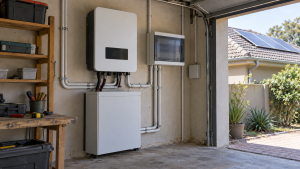
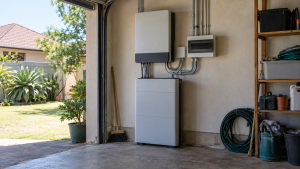
Site selection and environmental considerations
You need to place your battery in an area that remains dry and avoids direct, intense sunlight throughout the day. Extreme ambient temperatures will cause the battery management system to limit charge or discharge power to protect its internal hardware, which lowers your total energy yield. Keeping your equipment indoors or in a well-insulated, climate-controlled container helps maintain consistent performance during all seasons.
Selecting appropriate cabling and protection devices
Cable thickness is determined by the total current that your battery bank will pull or deliver at peak load. Using incorrectly sized wiring will cause voltage drops and unnecessary heating, reducing overall system efficiency. Adhering to these standards ensures safe operation:
- Use high-quality copper cabling that matches the current rating of your inverter.
- Install a dedicated circuit breaker between the battery and the hybrid inverter.
- Ensure all connection points are tight and cleaned to prevent localized resistance.
- Secure all cabling paths to avoid mechanical stress on the terminals.
These simple measures prevent energy loss and contribute to a safer electrical environment for your entire home.
Ensuring proper ventilation and clearance requirements
While LiFePO4 batteries produce less heat than other chemistries, they still generate thermal output during heavy cycling. You must ensure at least 100mm of clearance around all sides to allow air to circulate freely around the casing. Without this space, the unit will struggle to shed excess heat, forcing it to derate its performance unexpectedly.
Managing systems with the Freedom Won BMS
Communicating with third-party solar inverters
The battery management system (BMS) acts as the brain of your installation, reporting state-of-charge and health status to your inverter via communication cables. When the protocols are matched, the inverter reads this data in real time to optimise its charging algorithm. This active dialogue is the only way to ensure your battery reaches a true 100% state-of-charge without overstressing the cells.
Interpreting status indicators and diagnostics
Most units feature LED indicators on the front panel that signal the current health of the BMS and the battery cells. A solid green light usually indicates normal operation, while flashing sequences reveal fault codes or communication warnings that require your attention. You can view the technical community forum to troubleshoot specific light patterns that occur during daily use.
Updating firmware to maintain system compatibility
Manufacturers release occasional firmware updates for the BMS to improve how it handles voltage balancing and solar integration. Installing these updates helps your system stay current with new inverter developments and can iron out minor glitches in communication reporting. Always perform these updates during a period where your system is fully charged to ensure the process completes without interruption.
Maximising the lifespan of your installation
Standard maintenance schedules for energy storage
Visual inspections of your connections and cabling are the most effective maintenance task you can perform. Every six months, take a moment to check for signs of corrosion or loose terminals that might have developed over time. Keeping the area free of dust and debris also ensures that cooling vents remain unobstructed, which extends the electronic lifespan of the system.
Monitoring voltage balancing during heavy use
During times of high activity, the individual cells within your battery pack may drift slightly in their voltage. The BMS is designed to manage this balancing automatically, but you should still monitor the system through your inverter portal to ensure everything remains stable. If you notice a single cell deviating significantly from the others, contact your installer to investigate if there is an underlying issue with the pack cell matching.
Troubleshooting common communication errors
Communication errors are occasionally rooted in pinched or faulty data cables rather than the battery itself. If your inverter and battery stop communicating, replace the communication cord first to rule out physical damage. Only after physical checks should you begin looking into the BMS software configuration as the source of the persistent connection loss.
How the Freedom Won range compares to Fox ESS and Sigenergy
ZenSolar fits two brands and no others: Fox ESS and Sigenergy. Since that narrows what we can offer you, it deserves explaining rather than asserting.
First, what Freedom Won genuinely does well. Local manufacture is a structural advantage, not a marketing line: spares held in country, lead times that do not depend on a shipping schedule, and a local entity accountable for the product. The range is broad, the BMS is well understood by South African installers, and the track record is long. We would not tell you otherwise.
Where our two brands make a different argument. The case is not that the hardware above is bad. It is about what happens in years three to ten, which is where energy systems actually disappoint people.
One platform from a small house to a commercial site. The expensive mistake in home energy is outgrowing your ecosystem. Add a heat pump, a pool, an EV charger or a home office two years after commissioning and scaling often means changing brand — which means changing inverter, app and support channel at the same time. Fox ESS and Sigenergy both run continuous product families from single-phase residential through to three-phase commercial and industrial, so growth stays a capacity decision rather than a replacement decision.
Sigenergy is integrated rather than assembled. The SigenStor stack combines PV inversion, battery storage, system control and DC EV charging in one modular unit instead of four separately sourced boxes with four warranty conversations behind them. When something needs attention there is one manufacturer accountable for it. Most storage complaints turn out to be support complaints rather than hardware complaints, and this is the part that addresses them.
The warranty is written down, and we will show you the document. Sigenergy’s published warranty terms carry a 10-year period on the Sigen Battery and the Sigen Energy Controller, with the battery guaranteed to retain at least 60% of its usable capacity at 10 years, or a stated energy-throughput limit, whichever is reached first — extendable to 15 years if the system is purchased and registered within 12 months of commissioning. We quote those figures because we can point at the document they come from. Ask whoever else is quoting you to do the same; what happens next is informative.
Fox ESS is the volume-sensible half of the pair. Fox ESS sits behind Tsingshan Group and builds modular, stackable storage designed to be added to rather than replaced, across both single-phase and three-phase inverters. Where Sigenergy is the integrated premium answer, Fox ESS puts a well-specified system on a normal budget without dropping into the price tier where support quietly vanishes.
Whichever you choose, one thing decides more than the badge: every system we fit goes in through a manufacturer-approved installer, because that is what keeps the warranty valid on the day you need to use it. A warranty voided by an unapproved installation is worth exactly nothing, and that is true of every brand on this page.
Conclusion
A reliable storage installation comes from matching good components to professional installation and sensible operating practice. Understanding the underlying technology and respecting the battery’s operating requirements is what secures the performance you paid for.
ZenSolar fits Fox ESS and Sigenergy rather than Freedom Won. The reason is continuity and documentation: one manufacturer accountable for the inverter and the battery as a single system, warranty terms we can show you before you sign, and a platform that carries a household from its first battery through to a commercial installation without an ecosystem change halfway.
Frequently Asked Questions
What are the main signs that a battery is reaching the end of its functional life?
You will notice that the battery loses its usable energy capacity much faster than when it was new, or it may struggle to maintain voltage during high daily loads.
Is it safe to mix and match batteries from different chemical families in the same array?
No, you should never connect batteries of different chemistries or technologies to the same inverter bus, as their charge curves and voltage profiles will conflict and cause permanent damage.
How often should I perform a full charge cycle on a lithium storage system?
Lithium-based systems do not require frequent full cycles to prevent memory effects, but performing a periodic full charge helps the system perform accurate state-of-charge calibration.
Can I install my battery storage system in a garage that is not climate controlled?
This is possible, provided the garage stays within the manufacturer’s specified temperature limits for both charging and discharging, and remains protected from excessive humidity.
Does a larger nominal capacity always mean a better battery for my home?
Not necessarily, as a battery that is significantly oversized for your daily consumption will not provide any efficiency gains and will increase your initial capital expenditure unnecessarily.
Why does my battery management system limit output during extreme weather?
The BMS limits output to prevent the internal cell temperatures from exceeding safety thresholds, which is a built-in protective measure to ensure the long-term integrity of the cells.
What should I do if the system shuts down unexpectedly during a power outage?
First ensure that your inverter is still receiving power, then check the BMS fault codes on the battery; often a simple hard reset of the system can resolve transient logic errors.
Ready to take the next step with solar?
Speak to the ZenSolar team about the right system for your home or business — every system we sell is installed and supported through our manufacturer-approved installers.