Solar water heating gets oversold by installers and undersold by sceptics. The useful move is to sort the types by what they actually do on a South African roof rather than by what the marketing claims.
This guide walks through every solar geyser style sold locally, the way each one behaves during load reduction, and how to match it to your roof, water and budget.
What counts as a solar geyser
A solar geyser is any water heater whose main energy input comes from the sun rather than from the grid. In South Africa that covers three broad families: thermosiphon (direct) systems, split (indirect) systems, and PV-driven electric water heating that uses solar panels to feed a standard geyser element.
The first two are true solar thermal systems, with water or a heat-transfer fluid warmed in roof-mounted collectors. The third is an electrical workaround that has become common as rooftop PV has dropped in price.
Direct (thermosiphon) solar geysers
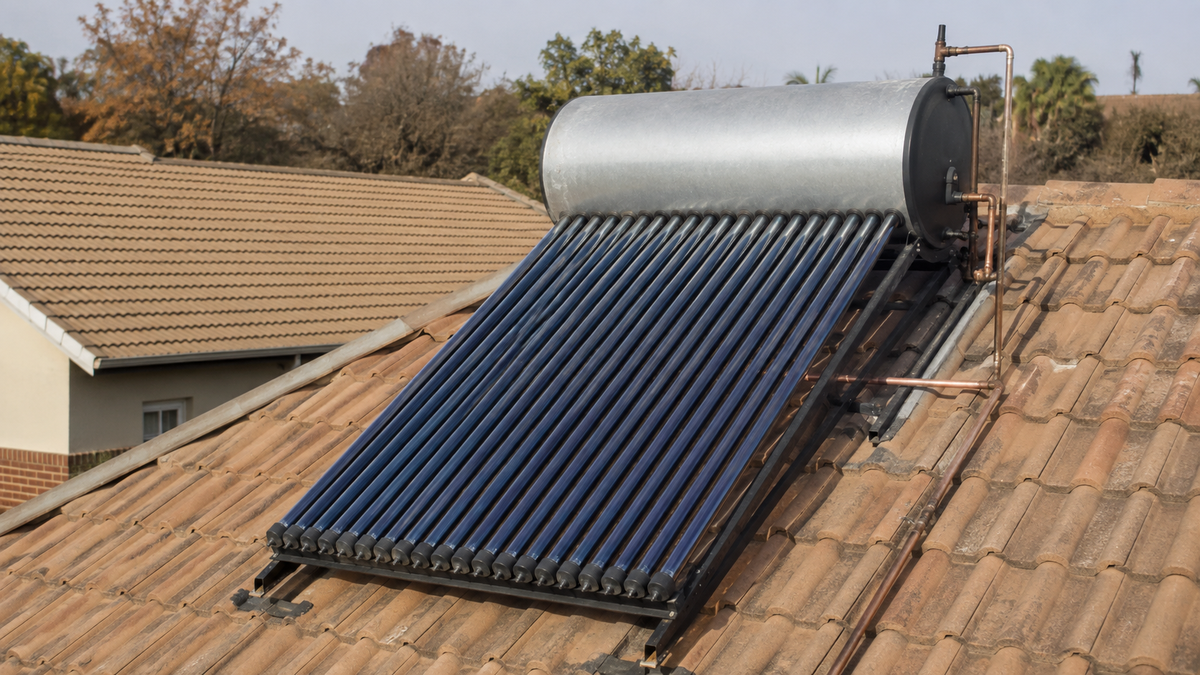
A direct, or thermosiphon, system puts the tank on the roof directly above the collectors. Cold water is heated in the collector and rises naturally into the tank, no pump needed.
The trade-off is weight on the roof and a hard rule on water quality. Hard water scales up the collector and slowly chokes the flow, which is why direct systems suit softer municipal supplies better than borehole water in high-mineral areas.
Because there is no pump and very little electronics, a thermosiphon unit is usually the cheapest to install and the easiest to live with. It also keeps working through load reduction without any backup kit, as long as the sun is out.
Indirect (split) solar geysers
An indirect, or split, system separates the tank from the collectors. A glycol mix circulates through the collectors, picks up heat, and transfers it to the water through a heat exchanger in the tank.
The split layout lets the tank live in the roof or against a wall, which is kinder to flat concrete roofs and to homes where a roof tank would look wrong. It also handles frost, hard water and slightly overcast days better than a direct system.
Flat plate collectors
Flat plate collectors are the boxy glass panels most people picture. They are efficient in strong, direct sun and tend to be cheaper per square metre than tubes.
They lose performance when shaded, and the internal piping can scale if the household runs on hard borehole water without treatment.
Evacuated tube collectors
Evacuated tube collectors look like rows of glass straws. Each tube loses very little heat, which helps on cool, cloudy winter mornings and in partial shade.
Tubes are also more forgiving of hard water because the heat-transfer path is shorter and easier to descale. They cost a little more than flat plates and are more fragile if hit by hail.
PV-driven electric water heating
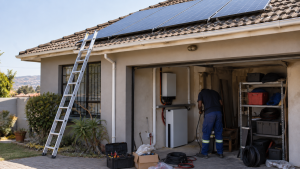
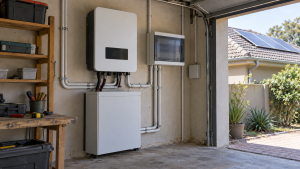
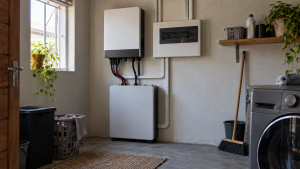
A PV-driven electric geyser is a standard electric geyser whose element is fed by rooftop solar panels, often through a hybrid inverter that already powers the rest of the house. There is no separate collector on the roof and no separate tank, which is the main appeal.
It is the cleanest fit for a home that already runs a PV and battery system. The inverter can divert spare solar to the geyser element during the day, so the geyser becomes a thermal battery that stores afternoon sun as hot water for the evening.
The catch is that the system depends on the inverter and on grid or battery power being available. During a deep outage with a flat battery, the element will not run.
Solar geyser vs heat pump
A heat pump is not a solar system at all. It pulls heat from the air and uses a refrigerant cycle, much like a reverse fridge, so it works day and night, cloudy or clear.
Heat pumps suit homes with reliable power and good air flow around the outdoor unit. A solar geyser suits homes that want hot water to keep working during outages and that have the roof space and orientation for collectors.
For households where load reduction is a daily fact, a thermosiphon solar geyser is the simplest path to hot water without the grid. The same household might still pick a heat pump for running cost if outages are short and rare.
Matching the type to your roof and water
Roof orientation is the first filter. A north-facing roof gives the strongest yield across the year, which is why installers always check this before quoting. Eskom notes that baseload availability has climbed from 9% two years ago to above 98% today, so grid backup is slowly becoming more useful, but the roof still does most of the work for a thermal system.
Shade is a deal-breaker for flat plates and a partial problem for tubes. If a large tree or a neighbouring building cuts afternoon sun off the collectors for most of the day, the system will underperform whatever the brochure says.
Water quality decides the collector type more than the brand. Hard borehole water scales indirect systems and slowly blocks evacuated tubes, so households in those areas either treat the water or budget for descaling every few years.
Flat concrete roofs complicate a thermosiphon install because the tank has to sit above the collectors. A split system with a ground-level tank is usually the cleaner answer.
Sizing the tank to your household
Rule-of-thumb sizing in South Africa runs at about 50 litres per person per day for a household that showers rather than baths. A family of four usually needs a 200L tank, while a couple can manage on 150L.
Number of bathrooms matters as much as number of people. Two bathrooms used morning and evening need a larger tank and, often, a larger collector, to recover between draws.
An oversized tank is not always better. It costs more and can lose heat overnight if it is poorly insulated, which is a real issue in high-altitude areas where nights run cold.
Backup heating for cloudy days and outages
Every practical solar geyser sold locally has a backup element, either electric or gas. The element handles winter overcast spells and recovers the tank after a long, cloudy stretch.
During load reduction, an electric backup is useless without power. Households that lose supply often will either fit a gas backup or size the solar side generously so the tank stays warm through a two-day outage.
A PV-driven electric geyser relies on the inverter and battery for backup, not on a separate element. This is the key behavioural difference between thermal solar and PV-driven heating.
Compliance, standards, and the installer
Solar water heaters should comply with SANS 1307 and related thermal standards. The electrical side of any backup element must be wired by a registered electrician, and the homeowner needs a Certificate of Compliance for that part of the installation.
On the grid side, small embedded generation rules apply through municipal by-laws. SAPVIA classifies embedded generation below 1MW as Small-Scale Embedded Generation, which covers rooftop solar and the meters a municipality may ask for.
Ask the installer for proof of registration with the relevant plumbing or electrical body, and keep the CoC with the rest of the house paperwork.
Choosing the right type for your home
Start with the roof. North-facing, unshaded, pitched and strong enough to carry a full tank, you have the widest choice. Thermosiphon for lowest cost, split with evacuated tubes for best all-round performance, or PV-driven heating if the rest of the house is already on solar.
Flat concrete roof or tricky orientation, lean toward a split indirect system with the tank mounted at ground level or against a wall. Hard borehole water, lean toward evacuated tubes and a planned descaling routine.
Budget follows the same logic. A basic thermosiphon unit is the cheapest entry point. A split system with evacuated tubes and a gas backup costs more but handles a wider range of conditions. PV-driven heating needs the rest of a PV and battery system to make financial sense, with typical payback depending on tariff, usage pattern and how much of the sun’s output would otherwise be exported.
Energy availability on the Eskom fleet has been climbing, with the year-to-date Energy Availability Factor at 65.85% according to Eskom, and the national tariff has risen by an average of 10% a year since 2014 per the CSIR. Both shifts make rooftop generation more attractive over time, though payback still depends on the household’s own tariff, consumption and usage pattern.
The honest read is that a solar geyser still earns its place next to a full PV and battery setup. The geyser stores energy as hot water for free, while the battery handles the rest of the load. Used together, they reduce the amount of stored electricity the home needs on a typical day.
FAQ
How long does a 150L solar geyser take to heat up?
A 150L direct system in good sun usually reaches a full tank by mid to late afternoon, while an indirect system takes a little longer because of the heat-exchanger step.
Which solar geyser is best in South Africa?
There is no single winner; a thermosiphon unit suits a simple north-facing roof, while a split indirect system with evacuated tubes handles harder conditions and shaded roofs better.
What is the difference between a direct and an indirect solar geyser?
A direct system heats drinking water inside the collector, while an indirect system uses a glycol loop and a heat exchanger, which protects the system from hard water and frost.
Can a solar geyser work on a flat concrete roof?
Yes, but a split indirect system with a ground- or wall-mounted tank is usually a cleaner install than a roof-mounted thermosiphon on a flat slab.
Do solar geysers still make sense if I have a PV and battery system?
Yes, because hot water storage is cheaper per useful kilowatt-hour than battery storage, and the two systems can share the same solar yield.
Book a site visit and we will check your roof, your water and your existing electrical setup before recommending a type.