
Solar Power & Backup Systems
Clean, alternative power backup that you can rely on. When Eskom load reduction kicks in, unpredictably, you are covered. With the right ‘package’ in place, you can run the essentials and not be deterred by power outages
What is a Household Solar System Made Up of?
The three essential component parts to a solar system are; the pv (photovoltaic) solar panels, the solar inverter and the energy storage, batteries.
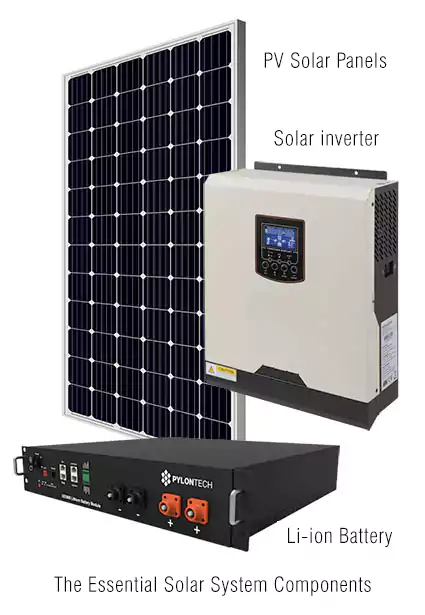
These components work in unison to give you converted power from the energy of the sun. This is what makes it renewable energy (energy from a source that is not depleted when used, such as wind or solar power).
A photovoltaic system typically includes an array of photovoltaic modules, an inverter, a battery pack for energy storage, charge controller, interconnection wiring, circuit breakers, fuses, disconnect switches, voltage meters, and optionally a solar tracking mechanism.
Solar power is renewable energy: derived from natural sources that are replenished at a higher rate than they are consumed. So you can feel good when using renewable energy. It is good for all concerned.
Calculating how much power is needed – then stack on this a safety measure – and you have peace of mind that you are covered when darkness falls and there is no power. Don’t be left powerless and at the mercy of Eskom.
Solar power, which is the heating of solar panels that then – through a power inverter – converts the DC power to AC, and you are functional again. Batteries store the DC power and when needed, it converts to AC power – which is what your electronics, computers, lights and so forth run on. Easy enough to understand.
Getting the Right Solar System for Your Household
It takes a short visit, and assessment of your peak power draw and a calculation can be made as to what is needed. There is nothing like having the peace-of-mind that you are backed up, and it is under your total contol.
While the sun shines, your batteries are being charged. And here in sunny South Africa, we have maximum sunshine – comparing to other parts of the world. With a hybrid system, you can use main power to charge your batteries – in the case of extended cloud coverage or those long rainy days.
Outage Kit
An Outage Kit contains a Solar Inverter, a Battery Bank and peripherals like disconnect switches and wiring. There are no panels with an Outage Kit. However, you can add panels later if you want to. Solar Batteries store DC (Direct Current) power, but we use AC (Alternating Current) in our homes.
The inverter will convert the grid-supplied AC power to DC power when your battery is charging. And when using the power stored in your battery, the inverter will convert the DC power to usable AC power.
Solar Power
As the name suggests, a Solar Power Kit contains a Solar Inverter, Battery Bank, Peripherals and Solar Panels. Solar Power Kits supplement your usage with freely produced solar power during the day and supply power during outages because you have a battery bank.
More often than not, your Solar Panels will charge your battery bank during the day so that you can use the stored solar power in the evenings and during grid failure. Solar Power Kits will save you money on electricity where Outage Kits will not.
Alternative Power
Solar energy is clean, eco-friendly and sustainable energy from the sun. Once installed, the system is fully under your control, and you get to enjoy uninterrupted power – even during outages (if you have installed a battery backup system with your solar panels). There is nothing quite like having the confidence and peace of mind in your own planning and investment in a solar energy system.
Solar can lower your bills, protect you from power cuts, and show customers you care about the planet while locking in your bill from price hikes for years to come.
It starts with a consultation to assess your business’s energy needs, followed by a custom system design, installation, and integration with your existing electrical infrastructure. Ongoing monitoring and maintenance are typically included.
Costs vary based on system size and specific requirements, but a tailored quote is provided after an assessment. Larger systems generally have a lower cost per watt.
Yes, various financing options (loans, leases, PPAs) are available to make commercial solar more affordable. Speak to a tax practitioner about any business tax allowances that may currently apply to your business.
Savings depend on system size, energy usage, and local rates. Many businesses offset a large portion of their electricity costs, sometimes up to 100%.
Commercial solar systems require minimal maintenance, but periodic inspections and occasional cleaning are recommended to maintain efficiency.
Yes, you’ll continue to receive a bill for any grid electricity used and fixed charges, but solar can greatly reduce your overall costs. Net metering can further offset charges.
Installation timelines vary based on system size, site complexity, permitting, and utility requirements. A solar consultant can provide a more precise estimate.
No. Over time, solar energy is typically more affordable than utility power, as it is not subject to market volatility and rising electricity rates.
Ready to Get Started?
Zensolar
Commercial and residential solar specialists
We help South African families and businesses break free from rising electricity costs with custom solar solutions that can cut your bills by up to 92% from day one. From consultation to installation, we make going solar simple so you can enjoy energy independence and predictable monthly savings In Gauteng, NW, Cape town and KZN
Address
51 Gustav Preller St, Vorna Valley, Midrand.
Phone
+27 11 045 9062