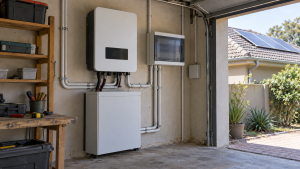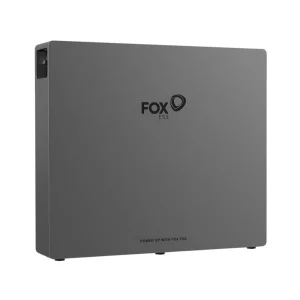
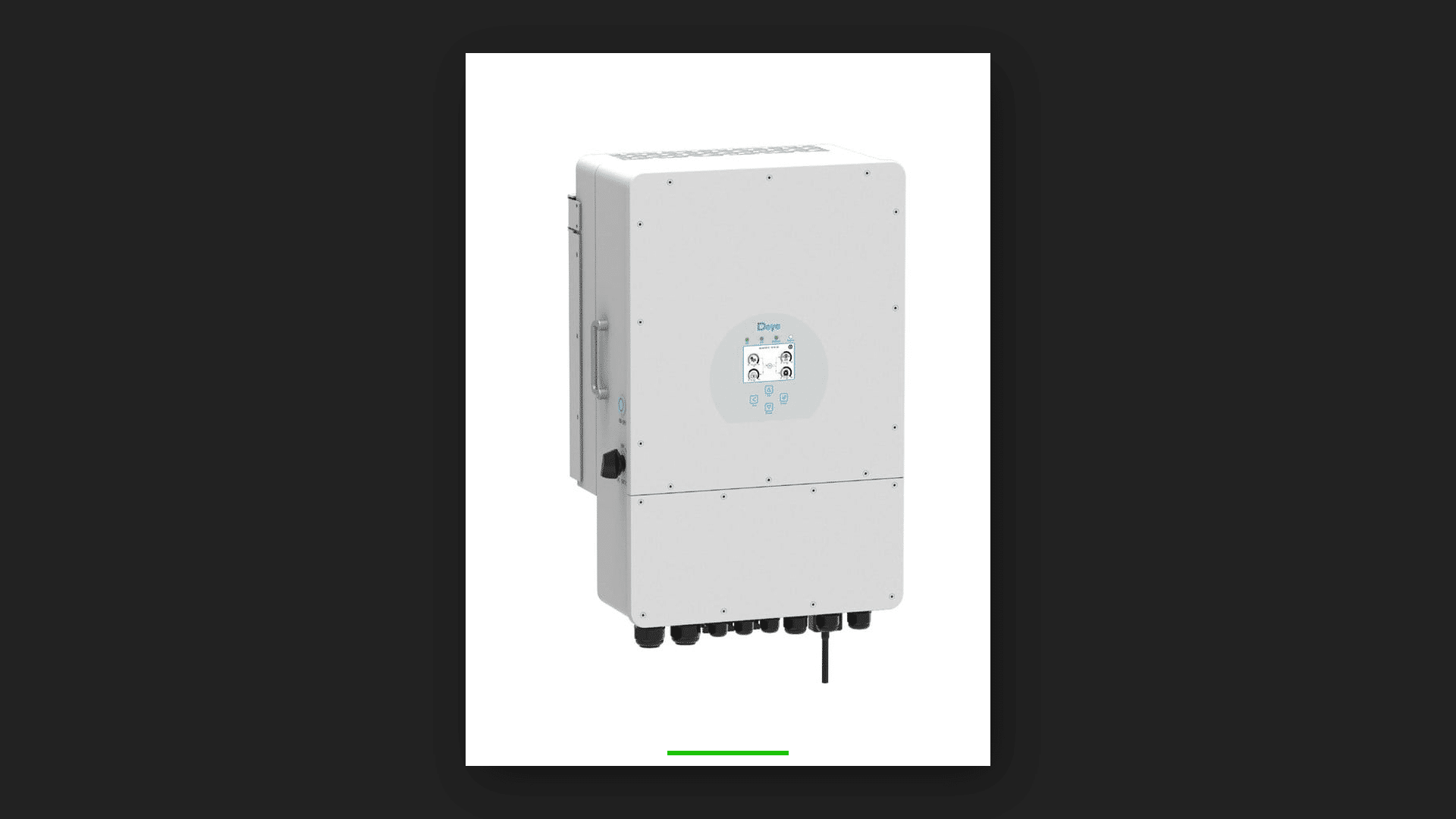
Search “Deye inverter reviews” and you’ll find the usual mixture: five-star write-ups sitting next to furious one-star posts from people whose systems misbehaved, with nothing to tell you which experience is more likely to be yours. We’re not going to add another star rating to that pile. ZenSolar does not sell Deye — we fit Fox ESS and Sigenergy, and we set out why at the end — so treat what follows with that in mind too. Our aim here is a straight answer: what Deye is as a manufacturer, where its reputation genuinely holds up, where it doesn’t, and what decides whether the inverter on your wall performs the way the good reviews describe.
Pros and cons at a glance
Before the detail, here’s the short version of what holds up about Deye in the South African market, and what doesn’t.
- Pro: broad battery compatibility. Deye hybrids pair with the major lithium battery brands sold locally, including Freedom Won, Hubble and Pylontech.
- Pro: a wide model range on one platform. The same design logic runs from small single-phase homes through to three-phase commercial sites, so monitoring and operation stay consistent as a property’s needs grow.
- Pro: strong value positioning. Deye is frequently the sharper-priced option among the major hybrid brands, at a time when hardware costs across the industry sit well below where they were a few years ago.
- Con: the range is broad enough to get wrong. With this many models and battery pairings available, picking the wrong size or an incompatible battery is easy if you’re not working from a proper design, not a guess.
- Con: the buying channel matters more than people expect. A grey-import or second-hand Deye unit strips out the warranty and support that make the hardware worth buying in the first place.
- Con: reviews are mixed, and not always about the inverter. Like most high-volume manufacturers, a share of Deye’s negative reviews trace back to installation and sizing decisions rather than the hardware itself, which is exactly why we’ve written the section below.
Who makes Deye inverters?
Deye is one of the world’s major manufacturers of hybrid solar inverters, producing at a scale that puts its equipment into markets across the globe. In South Africa the brand has become one of the most commonly installed hybrid platforms, with a range running from compact single-phase units for townhouses through to three-phase machines for large properties and commercial sites. ZenSolar does not supply Deye. We fit Fox ESS and Sigenergy, and the section below sets out why. If you want the head-to-head in more depth, our Fox ESS vs Deye comparison goes further on that specific matchup.
Scale matters in this product category for a practical reason: a manufacturer shipping enormous volumes accumulates field data, iterates firmware, and sustains a spare-parts and support pipeline. It’s also why the brand’s hardware is so widely understood by South African installers. That familiarity is an underrated reliability factor, because the person configuring the machine has usually configured hundreds like it.
Is Deye a good inverter brand? What its reputation rests on
Strip away the star ratings and Deye’s reputation in South Africa rests on a short list: a hybrid-first design built around how South Africans use solar day to day (panels, battery and grid in one unit, with time-of-use logic that stores midday production for the expensive evening hours), the battery compatibility and value positioning already covered above, and a track record of firmware updates and spare-parts support that comes from selling at real volume. None of that guarantees your installation will go well. It does mean the platform itself has held up.
Deye vs Sunsynk: how the comparison plays out
This is the question we get asked more than any other, and it’s the comparison that dominates the wider search results too. Both brands are credible, both are widely installed in South Africa, and both are sold and supported through ZenSolar. Here’s how they stack up on the things that matter, rather than on brand loyalty:
| What buyers compare | Deye | Sunsynk |
|---|---|---|
| Manufacturer scale | One of the highest-volume hybrid inverter manufacturers supplying the South African market. | Also a high-volume manufacturer with a long-established footprint here. |
| Local installer familiarity | Widely installed and well understood by South African solar installers. | Equally familiar to most accredited installers in the local market. |
| Battery compatibility | Works with the major lithium battery brands sold locally, including Freedom Won, Hubble and Pylontech. | Also compatible with the same major local battery brands, via its own approved list. |
| Range breadth | Spans single-phase residential units through to three-phase commercial models on one consistent platform. | Covers a similar span from residential to commercial installations. |
| Price positioning | Often the sharper-priced option at a given size. | Positioning varies by model, so it’s worth comparing at the specific size you need rather than by brand alone. |
| Support in South Africa | Sold and supported through ZenSolar’s manufacturer-approved installers, with warranty claims managed through the local distributor. | Sold and supported the same way, through ZenSolar’s manufacturer-approved installers. |
In practice, the honest answer is that neither brand is categorically better. The choice usually comes down to which specific model fits your supply type, your battery plans and your budget at the size you need. A designer working from your real consumption numbers can justify the recommendation in terms you can check, rather than in terms of which nameplate sounds more trustworthy.
How to read solar inverter reviews without being misled
Here’s the uncomfortable truth about inverter reviews, Deye’s included: most bad solar experiences are installation and design failures, not hardware failures. An inverter that was undersized for the property, paired with too little battery, programmed carelessly or wired by an unaccredited installer produces a miserable owner, who then reviews the brand on the nameplate rather than the workmanship behind the wall. When you read reviews, filter for:
- Was the system professionally designed and installed? Reviews that mention an accredited installer, a Certificate of Compliance and a commissioning process are describing the product. Reviews of self-installed or bargain-basement jobs are describing the job.
- Is the complaint about the inverter, or about expectations? “My battery is flat by 8pm” is nearly always a sizing conversation. Our guide on how to size a solar system shows why capacity, not brand, decides that outcome.
- Was the fault resolved under warranty? Every manufacturer at global scale has some unit failures. What distinguishes brands is whether the support chain resolves them. A review that ends “and it was replaced under warranty” is, oddly, a good sign.
- Is the reviewer in South Africa? Grid conditions, tariff structures and support channels differ by country. A frustration from another market may simply not apply here.
The specs that actually matter when comparing
Rather than absorbing spec-sheet numbers from reviews, evaluate any Deye model (or any competitor) against your own requirements on these axes:
- Continuous output power: can it run your home’s real simultaneous load, measured rather than guessed?
- Surge handling: motors (pool pumps, boreholes, compressors) draw multiples of their running power at startup. The inverter must absorb that.
- Solar input capacity: how much panel power it can accept. This sets your harvest ceiling and your room to expand the array later.
- Battery compatibility: confirm your intended battery is on the approved list with proper communications support, not merely “it works”.
- Supply match: single-phase or three-phase, matching your property’s connection.
- Warranty and support channel: a local, written warranty honoured through your supplier, the paperwork that turns a specification into an assurance.
We’re deliberately not printing a spec sheet or a price table here. Deye’s range spans several models and revisions, and a number quoted in an article today can be wrong by the time you read it. The reliable way to check current specifications and pricing for the model size you need is our System Sizer, which matches your actual consumption to a real, current listing rather than a review’s best guess. How these choices interact with the rest of the system (panels, battery, protection, workmanship) is covered in our guide to the best solar system for a home in South Africa.
What if something goes wrong? Understanding the warranty process
Search around online and you’ll find frustrated posts about after-sales support: slow responses, unclear next steps, difficulty getting a straight answer once something has failed. Those complaints are worth taking seriously, and they’re usually not about whether the inverter works, they’re about what happens after it doesn’t.
This is where the buying channel matters as much as the brand. Buy a Deye inverter through an official, accredited channel and the warranty claim is managed for you: the retailer or installer liaises with the local distributor, handles the paperwork, and pushes the process along. Buy a grey-import unit or a second-hand one with no clear history, and you’re often left dealing with the manufacturer’s support structure directly, in a market that isn’t its primary focus.
ZenSolar’s position here is straightforward: we do not supply Deye, so we cannot run a Deye warranty claim for you. On the two brands we do fit — Fox ESS and Sigenergy — we handle the claim through the local distributor on your behalf, and every installation goes through a manufacturer-approved installer rather than an ad hoc arrangement, which is precisely what keeps the warranty valid when you need it. That’s not a guarantee that nothing will ever go wrong. It’s a guarantee that if something does, there’s an identifiable channel responsible for sorting it out.
Reliability in practice: what determines whether your Deye performs
Three factors dominate real-world reliability, and only one of them is the manufacturer:
- Installation quality. Correct cable sizing, protection devices, ventilation and mounting location decide how hard the electronics work every day. Heat is the enemy of all power electronics; a cool, ventilated installation position is worth more than any review score. ZenSolar installations run through our manufacturer-approved installers for exactly this reason.
- Correct configuration. Battery parameters, work modes and time-of-use programming set at commissioning determine both performance and battery lifespan.
- System design honesty. A system sized to the property’s measured consumption performs like the reviews you hoped for. The classic failure patterns are catalogued in 7 costly solar mistakes to avoid at design stage.
How Deye compares to Fox ESS and Sigenergy
We fit two inverter and battery brands and no others: Fox ESS and Sigenergy. Since that narrows what we can offer you, it is worth explaining rather than asserting.
First, what Deye genuinely does well. Deye is a large-scale manufacturer with unusually deep installer familiarity in South Africa, wide battery compatibility across lithium and lead-acid, a dedicated generator port, and parallel capability up to sixteen units for properties with serious demand. That combination is why so many local systems run on it, and it is not a reputation we are going to argue with. If your installer knows Deye intimately and your design fits it, you will very likely be fine.
Where our two brands make a different argument. The case is not that Deye is a bad inverter. It is about what happens in years three to ten, which is where storage systems actually disappoint people.
One platform from a small house to a commercial site. The expensive mistake in residential energy is outgrowing your ecosystem. Add a heat pump, a pool, an EV charger or a home office two years in, and scaling often means changing brand — which means changing inverter, app and support channel at once. Fox ESS and Sigenergy both run continuous families from single-phase residential through to three-phase commercial and industrial, so growth stays a capacity decision rather than a replacement decision.
Sigenergy is integrated rather than assembled. The SigenStor stack combines PV inversion, battery storage, system control and DC EV charging in one modular unit instead of four separately sourced boxes with four warranty conversations behind them. When something needs attention there is one manufacturer accountable for it. Most storage complaints are support complaints, not hardware complaints, and this is the part that addresses them.
The warranty is written down, and we will show you the document. Sigenergy’s published warranty terms carry a 10-year period on the Sigen Battery and the Sigen Energy Controller, with the battery guaranteed to retain at least 60% of its usable capacity at 10 years, or a stated energy-throughput limit, whichever is reached first — extendable to 15 years if the system is purchased and registered within 12 months of commissioning. We quote those figures because we can point at the document they come from. Ask whoever else is quoting you to do the same; what happens next is informative.
Fox ESS is the volume-sensible half of the pair. Fox ESS sits behind Tsingshan Group and builds modular, stackable storage designed to be added to rather than replaced, across both single-phase and three-phase inverters. Where Sigenergy is the integrated premium answer, Fox ESS puts a well-specified system on a normal budget without dropping into the price tier where support quietly vanishes.
Should you buy one?
If your property needs a hybrid inverter and the model fits your supply type, loads and battery plans, Deye is a genuinely credible choice, and we would rather say so than pretend otherwise. The brand question still matters less than the design question, and a well-designed Deye system beats a badly designed anything.
Our answer is that we would fit you a Fox ESS or a Sigenergy instead, for one stated reason: we can put the warranty terms in front of you before you sign, one manufacturer stays accountable for the whole stack, and the system can grow with the house without a brand change. That is the specific thing we are selling, and it is why we narrowed to two brands rather than carrying whatever the distributor had in stock this quarter.
The financial case for acting is strong regardless of nameplate, with Eskom tariffs climbing above inflation while hardware costs sit well below their levels of a few years ago. Work through is a solar system worth it if you want that argument in full.
Frequently asked questions
Is Deye a good inverter brand?
Yes, on the evidence that matters most: manufacturing scale, local installer familiarity, and broad battery compatibility. Where reviews turn negative, the cause is usually the installation or the sizing, not the inverter, which is why we’ve covered both in detail above.
Is Deye the same as Sunsynk?
No, they’re separate manufacturers, and ZenSolar supplies neither — we fit Fox ESS and Sigenergy. See the comparison above for how the platforms differ in practice.
What batteries are compatible with Deye?
Deye hybrids work with the major lithium battery brands sold in South Africa, including Freedom Won, Hubble and Pylontech. ZenSolar fits none of those — our storage is Fox ESS and Sigenergy — but the compatibility rule is the same whoever supplies you: always confirm your specific battery and inverter model are on each other’s approved communication list before buying.
How many solar panels can a Deye inverter handle?
That depends on the specific model’s solar input rating, not a single figure that applies across the whole range. Run your intended panel count through our System Sizer to check it against the model you’re considering, rather than relying on a number from a review that may cover a different revision.
Do I need a professional to install a Deye inverter?
Yes. Professional installation through our manufacturer-approved installers is non-negotiable, for three reasons: it’s required to keep the warranty valid, it’s required for electrical safety, and you need the Certificate of Compliance it produces for insurance and resale. Skip that step and you’re not really testing the Deye platform when something goes wrong, you’re troubleshooting your own wiring.
Where should I NOT buy, whatever the reviews say?
Grey-import listings and second-hand units. However good the platform, a unit without a valid local warranty or with an unknown operating history carries a risk no review score offsets. Buy new, through an identifiable South African channel, with the warranty process in writing.
Get a recommendation based on your house, not the internet
The most useful “review” is a design exercise against your own consumption. Run your details through our free System Sizer to see what your property actually requires, or start with the solar ROI assessment for the financial picture. ZenSolar will quote you a complete, personalised system sized to your real usage and installed by a manufacturer-approved installer. That quote will be built on Fox ESS or Sigenergy — those are the two brands we fit, and we do not supply Deye. Fox ESS carries a 10-year swap-out warranty, so a unit that fails inside the term is replaced rather than repaired. A properly designed, properly commissioned system is the version of the product the good reviews are describing, whichever brand you end up buying.
Not sure which system is right for you?