There are three ways to heat water, and they don’t cost the same
Every South African home heats water one of three ways: an electric element drawing straight from the grid, a gas burner running on LPG, or a solar collector using the sun’s heat for free. All three work, and none of them is right for every household. The honest answer depends on how much hot water you use, what your roof can support, and how you weigh a bigger bill once against a bigger bill every month for years afterward.
We sell solar equipment, which means it would suit us if solar always won this comparison. It doesn’t. Households with very light hot water use, an unsuitable roof, or a short time left in the home are often genuinely better off with gas or electric. This guide sets out what each option costs to buy and run, where each one falls short, and how to work out which one actually fits your situation.
Solar, gas and electric geysers at a glance
Before the detail, here’s how the three options compare on the factors that decide most people’s choice: what you pay upfront, what you pay to run, how installation works, and what your property needs to support it.
| Factor | Electric geyser | Gas geyser | Solar geyser |
|---|---|---|---|
| Upfront cost | Lowest of the three | Mid-range, once the unit and cylinder setup are included | Highest of the three, reflecting the extra equipment and installation work |
| Running cost | Highest of the three, and it climbs whenever Eskom tariffs rise | Mid-range, tied to LPG cylinder prices rather than electricity tariffs | Lowest once installed, since the core energy source is free |
| Installation | Simplest. Any qualified plumber can fit or replace one | Needs a qualified installer, correct ventilation and sign-off | Needs a qualified installer, correct roof orientation and accurate sizing |
| Space and roof needs | Compact, fits almost anywhere | Compact, but needs ventilation and somewhere to store cylinders | Needs a reasonably unshaded, well oriented roof |
Electric geysers: the incumbent
Electric is what most South African homes already have, and it remains the default for a reason.
Strengths:
- Lowest upfront cost of the three
- Familiar to every plumber, so repairs and replacements are quick to arrange
- Works identically no matter the weather
Weaknesses:
- Highest running cost of the three, and that cost increases every time tariffs go up
- Water heating is typically the largest single item on a household electricity bill, which makes the electric geyser the most expensive appliance you own over its lifetime, even though it was the cheapest to buy
Best for: households with very low hot water use, or as the backup element inside a solar system.
Gas geysers: instant and independent
Gas solves a different problem. It heats water the moment you need it, rather than storing it hot around the clock.
Strengths:
- Heats water on demand, so nothing sits stored and hot overnight
- Unaffected by grid conditions
- Compact footprint
Weaknesses:
- You’re swapping one purchased energy source for another. LPG has to be bought, delivered and stored in cylinders, and its price moves with fuel markets rather than Eskom tariffs
- Ventilation requirements limit where a unit can go, and installation must be done by a qualified installer and signed off appropriately
Best for: homes with space constraints, holiday homes with occasional occupancy, and households that specifically want on demand heating.
Solar geysers: highest saving, needs the right roof
Solar asks for more upfront and more care in the installation, in exchange for the lowest ongoing cost of the three.
Strengths:
- Once installed, the energy itself is free
- South Africa has strong solar conditions for this, so a correctly sized system can carry most of the annual hot water load without buying energy from anyone
- Paired with a small backup element, comfort holds up even on days the sun doesn’t
Weaknesses:
- Highest upfront cost of the three
- Performance depends on a reasonably unshaded, well oriented roof
- Sizing and installation quality matter more here than they do for the other two options
Best for: owner occupied homes with daily hot water use and a suitable roof, which describes most family homes in Gauteng.
Understanding your solar geyser options
Solar geysers aren’t one product. Two decisions shape how a system behaves on your specific roof.
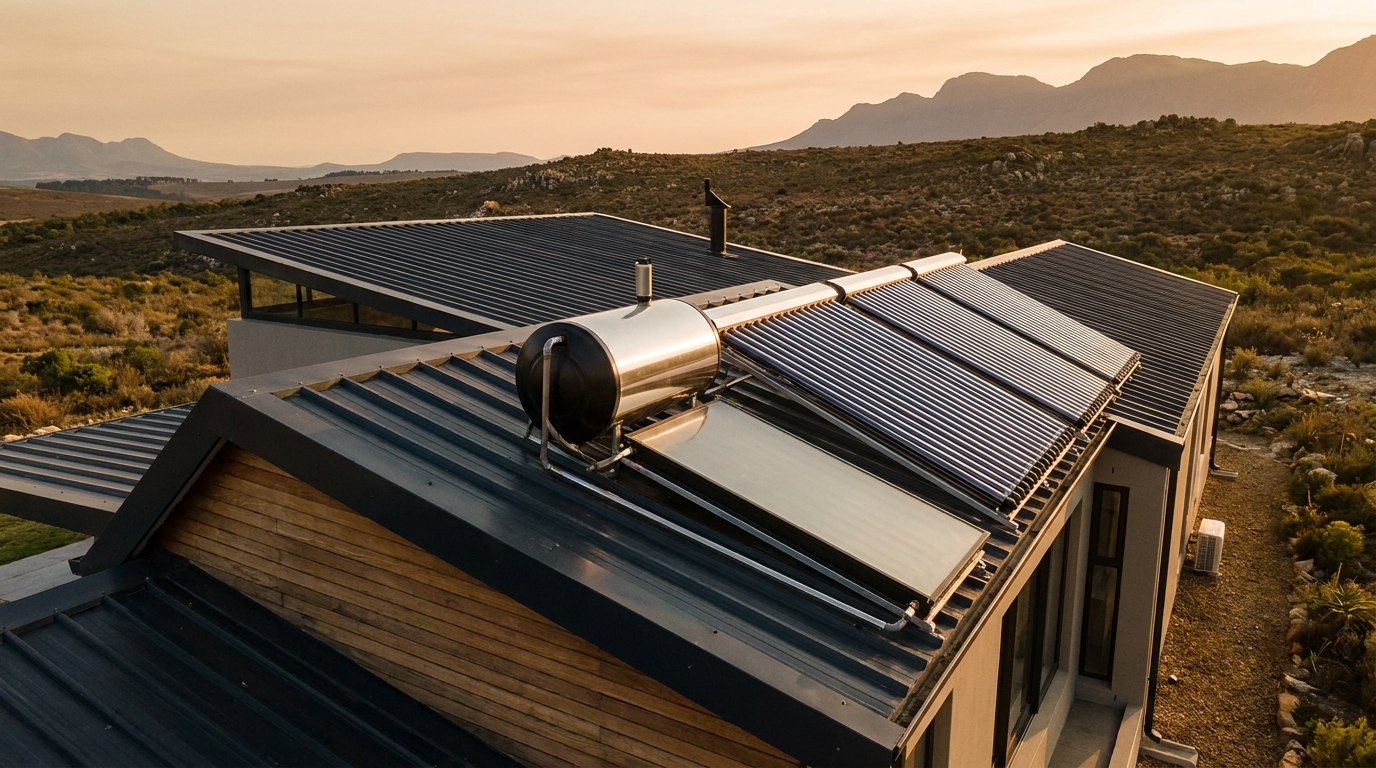
The first is collector type. Flat plate collectors use a simple insulated panel to absorb heat, and they’re the more common, lower cost choice. Evacuated tube collectors use sealed glass tubes with a vacuum layer, which hold onto heat better in cold or overcast conditions. Either can be the right call depending on your climate and budget, and a manufacturer-approved installer can advise on which suits your roof.
The second is direct versus indirect circulation. A direct (open loop) system circulates your household water straight through the collector, which is simpler and works well across most of the country. An indirect (closed loop) system circulates a separate heat transfer fluid through the collector and passes that heat to your water through an exchanger, which protects the system from frost. That distinction matters more in colder inland areas than it does somewhere that rarely sees a hard frost.
What about heat pumps?
If your roof can’t support a solar geyser, an electric heat pump is worth asking about before you default back to a standard electric unit. Rather than generating heat directly with a resistive element, a heat pump moves heat from the surrounding air into your water, which uses grid electricity more efficiently than a standard electric geyser does. It still depends entirely on the grid, so it doesn’t give you the same independence as solar, but it can lower your running cost without needing a suitable roof. Worth raising with your installer if solar genuinely isn’t an option for your property.
How to actually decide
- Do you own the home and plan to stay? The longer you stay, the more solar’s running-cost advantage compounds.
- How much hot water do you use daily? Heavy daily use favours solar. Light or intermittent use narrows the gap.
- What does your roof allow? A shaded or awkward roof pushes the answer toward gas, a heat pump, or a hybrid setup.
- How many people and bathrooms are you sizing for? Bigger households need bigger systems, and getting that number wrong in either direction costs you. Rather than guess, use our System Sizer or ask for a quote so the recommendation matches your actual household.
- Upfront budget. If capital is the constraint, financing can spread the cost of a solar installation against the monthly saving it creates. See our solar financing options.
Getting the installation right
Whichever option you choose, the installation matters as much as the equipment. Gas installations must be done by a qualified installer and signed off appropriately. That isn’t a formality, it’s what protects you and your household. Solar installations depend just as heavily on correct sizing, plumbing and roof mounting, which is why we work with our manufacturer-approved installers rather than leaving that step to chance.
The hybrid reality
In practice, many homes end up with a mix: a solar geyser doing the heavy lifting, an electric element as weather backup, and sometimes gas for a specific point of use like an outdoor bathroom. There’s no ideology in it, just matching each rand of energy spend to the cheapest source that does the job.
Frequently asked questions
Do solar geysers work in winter or on cloudy days?
Yes, but they lean more on the backup element on overcast days and through winter, and do more of the work themselves on sunny days. That’s the system working as intended, not a sign it was sized wrong.
Are gas geysers safe?
Yes, when installed and maintained correctly. Because gas involves combustion and a fuel supply, it’s not a job to hand to whoever’s cheapest. Installation must be done by a qualified installer and signed off appropriately.
Does a solar geyser add value if I sell the house?
There’s no fixed number for this, but buyers increasingly ask about running costs before they make an offer, and a solar geyser already in place answers that question for them before they need to ask it.
What maintenance does each system need?
Electric and gas geysers benefit from the same routine servicing as any water heating appliance. Solar geysers add a periodic check of the collector and its mounting, but day to day they don’t demand more attention than an electric unit once they’re installed correctly.
How long does a solar geyser last?
Longer than most people expect, provided it’s installed correctly and looked after. Exact lifespan varies by collector type and installation quality, which is another reason to have it fitted by an experienced, vetted installer rather than whoever quotes the lowest price.
How do I work out what size system I need?
Household size and hot water habits, how many people, how many bathrooms, whether use is concentrated in the morning, all affect the right size. Rather than rely on a rule of thumb, use our System Sizer or request a quote so the sizing matches your household instead of an average one.
Get a comparison for your own numbers
Our manufacturer-approved installer can assess your current geyser, usage and roof, and show you the comparison for your specific home rather than a generic table. Book your free solar consultation.
Not sure which system is right for you?